Question
If $A=\left[\begin{array}{cc}\sin ^2 \theta & \sec ^2 \theta \\ \operatorname{cosec}^2 \theta & \frac{1}{2}\end{array}\right]$ and $B=\left[\begin{array}{cc}\cos ^2 \theta & -\tan ^2 \theta \\ -\cot ^2 \theta & \frac{1}{2}\end{array}\right]$ the value of $A + B$ will be :
Answer

(D) $\left[\begin{array}{ll}1 & 1 \\ 1 & 1\end{array}\right]$

Need a full question paper?

Generate a complete, print-ready paper with questions like this in minutes — across 16+ boards, with answer keys.

Start Generating Free

Similar questions

$\int\frac{\text{x}^9}{(4\text{x}^2+1)^6}\text{ dx}$ is equal to:
  1. $\frac{1}{5\text{x}}\Big(4+\frac{1}{\text{x}^2}\Big)^{-5}+\text{C}$
  2. $\frac{1}{5}\Big(4+\frac{1}{\text{x}^2}\Big)^{-5}+\text{C}$
  3. $\frac{1}{10\text{x}}\Big(\frac{1}{\text{x}^2}+4\Big)^{-5}+\text{C}$
  4. $\frac{1}{10}\Big(\frac{1}{\text{x}^2}+4\Big)^{-5}+\text{C}$
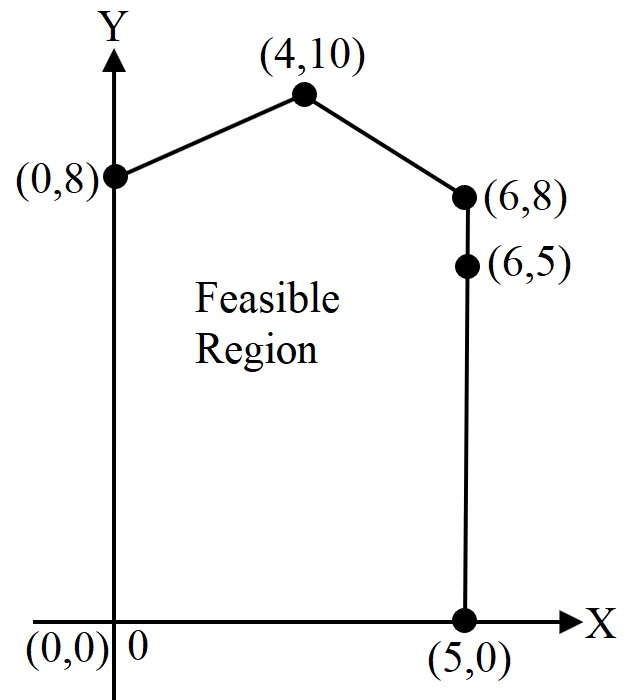
The feasible region for a LPP is shown shaded in the figure. Let Z = 3x - 4y be the objective function. Minimum of Z occurs at.
The direction cosines l, m, n of two lines are connected by the relations l + m + n = 0, lm = 0, then the angle between them is:
Which of these is equal to $\int e^{(x \log 5)} e^x d x$, where $C$ is the constant of integration?
Find the matrix $A^2$, where $A=\left[a_{i j}\right]$ is a $2 \times 2$ matrix whose elements are given by $a_{i j}=$ maximum $(i, j)-$ minimum $(i, j)$ :
If $\frac{\text{dy}}{\text{dx}}=3$ then y is equal to:
  1. 3x
  2. 0
  3. 3x + c
  4. $\frac{\text{x}}{3}+\text{c}$
If $\text{A}=\begin{bmatrix}1&-1\\2&-1\end{bmatrix},\text{B}=\begin{bmatrix}\text{a}&1\\\text{b}&-1\end {bmatrix}$ and $(A + B)^2 = A^2 + B^2,$ values of $a$ and $b$ are$:$
The number of solutions of the system of equations
2x + y − z = 7
x − 3y + 2z = 1
x + 4y − 3z = 5
  1. 3
  2. 2
  3. 1
  4. 0
In an LPP, if the objective function Z = ax + by has the same maximum value on two corner points of the feasible region, then the number of points of which Zmax occurs is:
  1. 0
  2. 2
  3. Finite
  4. Infinite
A box contains 10 good articles and 6 with defects. One item is drawn at random. The probability that it is either good or has a defect is,
  1. $\frac{64}{64}$
  2. $\frac{49}{64}$
  3. $\frac{40}{64}$
  4. $\frac{24}{64}$