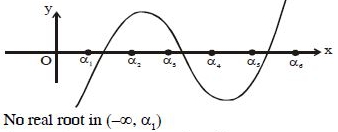
MCQ
If $\alpha_1<\alpha_2<\alpha_3<\alpha_4<\alpha_5<\alpha_6$, then the equation $(x-\alpha_1)(x-\alpha_3) (x-\alpha_5) + 3 (x-\alpha_2) (x-\alpha_4) (x-\alpha_6) = 0$ has :-
  • A
    No real root in $(\alpha_5,\alpha_6)$
  • B
    No real root in $(\alpha_1,\alpha_2)$
  • C
    All roots are imaginary
  • No real root in $(-\infty,\alpha_1)$

Answer

Correct option: D.
No real root in $(-\infty,\alpha_1)$
d

Need a full question paper?

Generate a complete, print-ready paper with questions like this in minutes — across 16+ boards, with answer keys.

Start Generating Free

Similar questions

If the probability of $A$ to fail in an examination is $\frac{1}{5}$ and that of $B$ is$\frac{3}{10}$Then, the probability that either $A$ or $B$ fails is
Let $F_1$ be the set of all parallelograms, $F_2$ the set of all rectangles, $F_3$ the set of all rhombuses, $F_4$ the set of all squares and $F_5$ the set of trapeziums in a plane. Then $F_1$ may be equal to:
Two families with three members each and one family with four members are to be seated in a row. In how many ways can they be seated so that the same family members are not separated ?
If the coefficent of $x^2$ in the expansion of $(1 + x)^m$ is $6$ then $m = .........$
All the points in the set $S\, = \left\{ {\frac{{\alpha \, + \,i}}{{\alpha \, - \,i}}\,:\,\alpha \, \in \,R} \right\}\,(i\, = \,\sqrt { - 1} )$ lie on a
Each of the persons $\mathrm{A}$ and $\mathrm{B}$ independently tosses three fair coins. The probability that both of them get the same number of heads is :
In a certain school, $74 \%$ students like cricket, $76 \%$ students like football and $82 \%$ like tennis. Then, all the three sports are liked by at least $......\%$
Let, $\alpha, \beta$ be the distinct roots of the equation $\mathrm{x}^2-\left(\mathrm{t}^2-5 \mathrm{t}+6\right) \mathrm{x}+1=0, \mathrm{t} \in \mathrm{R}$ and $\mathrm{a}_{\mathrm{n}}=\alpha^{\mathrm{n}}+\beta^{\mathrm{n}}$. Then the minimum value of $\frac{\mathrm{a}_{2023}+\mathrm{a}_{2025}}{\mathrm{a}_{2024}}$ is
If ${(r + 1)^{th}}$ term is the first negative term in the expansion of ${(1 + x)^{7/2}}$, then the value of $r$ is
${ }^{15} C_3+{ }^{15} C_5+\ldots .+{ }^{15} C_{15}$ will be equal to: