Question
If an automobile engine is overheated, it is cooled by putting water on it. It is advised that the water should be put slowly with engine running. Explain the reason.

Answer

In a hot engine the hot parts are expanded because of heat, if cold water is poured suddenly then there will be uneven thermal contraction in the parts. This will result in a stress to develop between the various parts of the engine and may let the engine to crack down.

Need a full question paper?

Generate a complete, print-ready paper with questions like this in minutes — across 16+ boards, with answer keys.

Start Generating Free

Similar questions

Read the passage given below and answer the following questions from 1 to 5. First Law of Thermodynamics The first law of thermodynamics is the general law of conservation of energy applied to any system in which energy transfer from or to the surroundings (through heat and work) is taken into account. It states that the energy supplied to the system goes in partly to increase the internal energy of the system and the rest in work on the environment. Mathematically, $\triangle\text{Q}=\triangle\text{U}+\triangle\text{W}$ where $\triangle\text{Q}$ is the heat supplied to the system, $\triangle\text{W}$ is the work done by the system and $\triangle\text{U}$ is the change in internal energy of the system. $\triangle\text{Q}$ and $\triangle\text{W}$ depend on the path taken to go from initial to final states, but the combination $\triangle\text{Q}​​-​​\triangle\text{W}$ is path independent.

  1. The first law of thermodynamics is concerned with conservation of:
  1. Number of molecules
  2. Number of moles
  3. Energy
  4. Temperature
  1. Which of the following is not a path function?
  1. $\triangle\text{Q}$

  2. $\triangle\text{Q}​​+\triangle\text{W}$

  3. $\triangle\text{W}$

  4. $\triangle\text{Q}​​-​​\triangle\text{W}$

  1. An electric heater supplies heat to a system at a rate of 120W. If system performs work at a rate of 80 J s-1, the rate of increase in internal energy is:
  1. 30 J s-1
  2. 40 J s-1
  3. 50 J s-1
  4. 60 J s-1
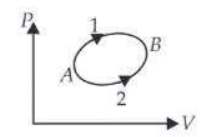
  1. Asystem goes from A to B by two different paths in the P - V diagram as shown in figure. Heat given to the system in path 1 is 1100 J, the work done by the system along path 1 is more than path 2 by 150 J. The heat exchanged by the system in path 2 is:

  1. 800 J
  2. 750 J
  3. 1050 J
  4. 950 J
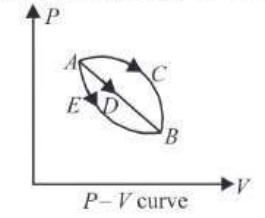
  1. A certain mass of gas is carried from A to B, along three paths via ACB, ADB and AEB. Which one of the following is correct?

  1. Work done via path ACB is minimum.
  2. Work done via path ADB is maximum.
  3. Work done via path ACB is maximum.
  4. Work done via path AEB is maximum.
Read the passage given below and answer the following questions from (i) to (v).
Kelvin-Planck statement: No process is possible whose sole result is the absorption of heat from a reservoir and the complete conversion of the heat into work.
Clausius statement: No process is possible whose sole result is the transfer of heat from a colder object to a hotter object. It can be proved that the two statements above are completely equivalent.
A thermodynamic process is reversible if the process can be turned back such that both the system and the surroundings return to their original states, with no other change anywhere else in the universe. a reversible process is an idealized motion. A process is reversible only if it is quasi-static (system in equilibrium with the surroundings at every stage) and there are no dissipative effects. For example, a quasi-static isothermal expansion of an ideal gas in a cylinder fitted with a frictionless movable piston is a reversible process.
The free expansion of a gas is irreversible. The combustion reaction of a mixture of petrol and air ignited by a spark cannot be reversed. Cooking gas leaking from a gas cylinder in the kitchen diffuses to the entire room. The diffusion process will not spontaneously reverse and bring the gas back to the cylinder. The stirring of a liquid in thermal contact with a reservoir will convert the work done into heat, increasing the internal energy of the reservoir. The process cannot be reversed exactly; otherwise it would amount to conversion of heat entirely into work, violating the Second Law of Thermodynamics. Irreversibility is a rule rather an exception in nature.
  1. The diffusion process is:
  1. Reversible process
  2. Irreversible process
  1. A quasi-static isothermal expansion of an ideal gas in a cylinder fitted with a frictionless movable piston is
  1. Reversible process
  2. Irreversible process
  1. State Kelvin Planck statement.
  2. State Clausius statement.
  3. Define reversible processes and irreversible processes of thermodynamics.
A stone of mass 0.25 kg tied to the end of a string is whirled round in a circle of radius 1.5 m with a speed of 40 rev./min in a horizontal plane. What is the tension in the string? What is the maximum speed with which the stone can be whirled around if the string can withstand a maximum tension of 200 N?
The plate current, plate voltage and grid voltage of a 6F6 triode tube are related as $\text{i}_\text{p}=41(\text{V}_\text{p}+7\text{V}_\text{g})^{1.41}$ where Vp and Vg are in volts and ip in microamperes. The tube is operated at Vp = 250V, Vg = -20V. Calculate (a) the tube current, (b) the plate resistance, (c) the mutual conductance and (d) the amplification factor.
On a winter day, the outside temperature is 0°C and relative humidity 40%. The air from outside comes into a room and is heated to 20°C. What is the relative humidity in the room? The saturation vapour pressure at 0°C is 4.6mm of mercury and at 20°C it is 18mm of mercury.
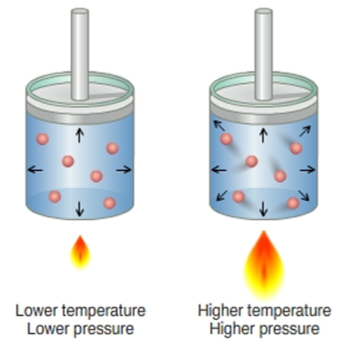
In a gas the particles are always in a state of random motion, all the particles move at different speed constantly colliding and changing their speed and direction, as speed increases it will result in an increase in its kinetic energy.
Image
1. If the temperature of the gas increases from 300 K to 600 K then the average kinetic energy becomes:
(a) same    (b) becomes double    (c) becomes half    (d) become triple
2. What is the average velocity of the molecules of an ideal gas?
(a) Infinite    (b) Same    (c) Increase    (d) Zero
3. Cooking gas containers are kept in a lorry moving with uniform speed. The temperature of the gas molecules inside will ___________.
(a) decrease    (b) Rises    (c) increase    (d) remains same
4. Find the ratio of average kinetic energy per molecule of Oxygen and Hydrogen:
(a) $1: 1$    (b) $4: 1$    (c) $1: 2$    (d) $1: 4$
OR
The velocities of the three molecules are $3 v , 4 v$, and 5 v . calculate their root mean square velocity?
(a) 4.0 v   (b) 4.02 v    (c) 4.08 v    (d) 4.04 v
By mistake, an eye surgeon puts a concave lens in place of the lens in the eye after a cataract operation. Will the patient be able to see clearly any object placed at any distance?
A bird while flying takes a left turn, where does it get the centripetal force from?
Read the passage given below and answer the following questions from (i) to (iv).
Zeroth Law of Thermodynamics states that two systems in thermal equilibrium with a third system separately are in thermal equilibrium with each other. The Zeroth Law clearly suggests that when two systems A and B, are in thermal equilibrium, there must be a physical quantity that has the same value for both. This thermodynamic variable whose value is equal for two systems in thermal equilibrium is called temperature (T). Thus, if A and B are separately in equilibrium with C, TA = TC and TB = TC. This implies that TA = TB i.e. the systems A and B are also in thermal equilibrium. Zeroth Law of Thermodynamics leads to the concept of internal energy of a system. We know that every bulk system consists of a large number of molecules. Internal energy is simply the sum of the kinetic energies and potential energies of these molecules. A certain amount of heat is supplied to the system’ or ‘a certain amount of work was done by the system its energy changes.
  1. Three thermodynamic systems are at temperature of 500 c .what can we say about them?
  1. Heat flows between them
  2. It obeys Zeroth Law of Thermodynamics
  3. Temperature of one system will increase and temperature of remaining two will decrease
  4. None of these
  1. Zeroth law of thermodynamics helped in the creation of which scale?
  1. Temperature
  2. Heat energy
  3. Pressure
  4. Internal energy
  1. State Zeroth Law of Thermodynamics:
  2. Define Internal energy of system:
Consider a gravity-free hall in which an experimenter of mass 50kg is resting on a 5kg pillow, 8ft above the floor of the hall. He pushes the pillow down so that it starts falling at a speed of 8ft/s. The pillow makes a perfectly elastic collision with the floor, rebounds and reaches the experimenter's head. Find the time elapsed in the process.