Question
If an automobile engine is overheated, it is cooled by putting water on it. It is advised that the water should be put slowly with engine running. Explain the reason.

Answer

In a hot engine the hot parts are expanded because of heat, if cold water is poured suddenly then there will be uneven thermal contraction in the parts. This will result in a stress to develop between the various parts of the engine and may let the engine to crack down.

Need a full question paper?

Generate a complete, print-ready paper with questions like this in minutes — across 16+ boards, with answer keys.
Start Generating Free

Similar questions

Write the equation of average power for $L - C - R$ series $AC$ circuit and discuss its special cases.
A deflection magnetometer is placed with its arms in north-south direction. How and where should a short magnet having $\frac{\text{M}}{\text{B}_\text{H}}=40\text{A-m}^2\text{T}$ be placed so that the needle can stay in any position?
To keep valuable instruments away from the earth's magnetic field, they are enclosed in iron boxes. Explain.
On a winter day, the outside temperature is 0°C and relative humidity 40%. The air from outside comes into a room and is heated to 20°C. What is the relative humidity in the room? The saturation vapour pressure at 0°C is 4.6mm of mercury and at 20°C it is 18mm of mercury.
Some washing machines have cloth driers. It contains a drum in which wet clothes are kept. As the drum rotates, the water particles get separated from the cloth. The general description of this action is that "the centrifugal force throws the water particles away from the drum". Comment on this statement from the viewpoint of an observer rotating with the drum and the observer who is washing the clothes.
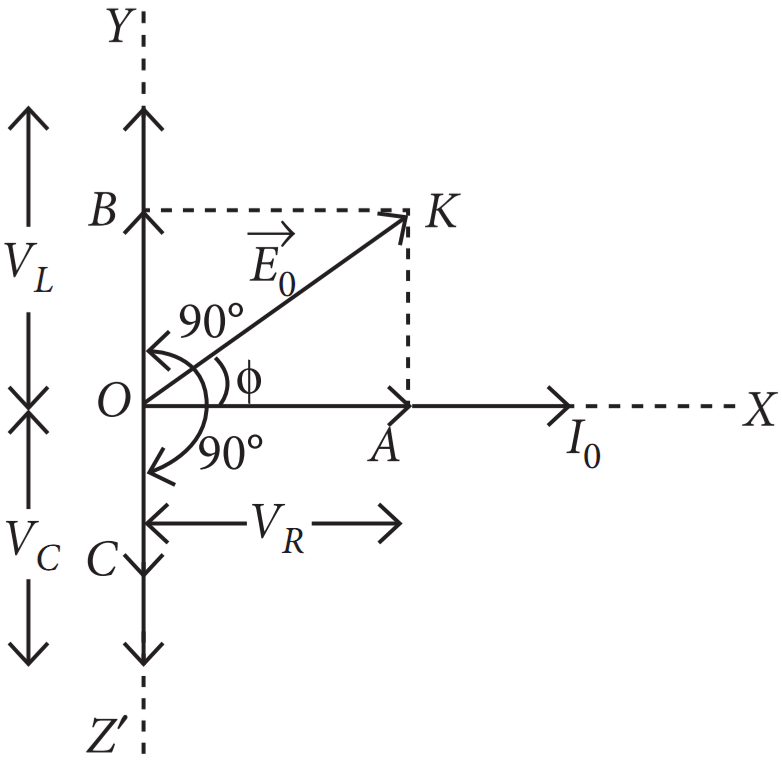
When a pure resistance R, pure inductor L and an ideal capacitor of capacitance C is connected in series to a source of alternating e.m.f., then current at any instant through the three elements has the same amplitude and is represented as $\text{I} = \text{I}_0\sin\omega\text{t}.$ However, voltage across each element has a different phase relationship with the current as shown in graph. The effective resistance of RLC circuit is called impedance (Z) of the circuit and the voltage leads the current by a phase angle $\phi.$

A resistor of $12\Omega,$ a capacitor ofreactance $14\Omega,$ and a pure inductor of inductance 0.1H are joined in series and placed across 200V, 50Hz a.c. supply.
  1. The value of inductive reactance is:
  1. $15\Omega$
  2. $31.4\Omega$
  3. $20\Omega$
  4. $30\Omega$
  1. The value of impedance is:
  1. $20\Omega$
  2. $15\Omega$
  3. $30\Omega$
  4. $21.13\Omega$
  1. What is the value of current in the circuit?
  1. $5A$
  2. $15A$
  3. $10A$
  4. $9.46A$
  1. What is the value of the phase angle between current and voltage?
  1. $53º9'$
  2. $63º9'$
  3. $55º4'$
  4. $50º$
  1. From graph, which one is true from following?
  1. $V_L \geq V_C$
  2. $V_L < V_C$
  3. $V_L < V_C$
  4. $V_L < V_C$
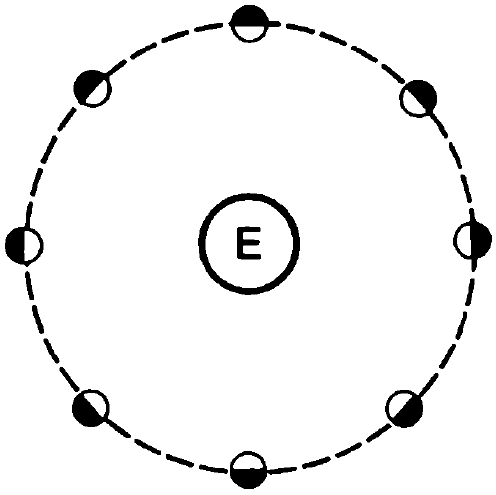
The moon rotates about the earth in such a way that only one hemisphere of the moon faces the earth. Can we ever see the ''other face'' of the moon from the earth? Can a person on the moon ever see all the faces of the earth?
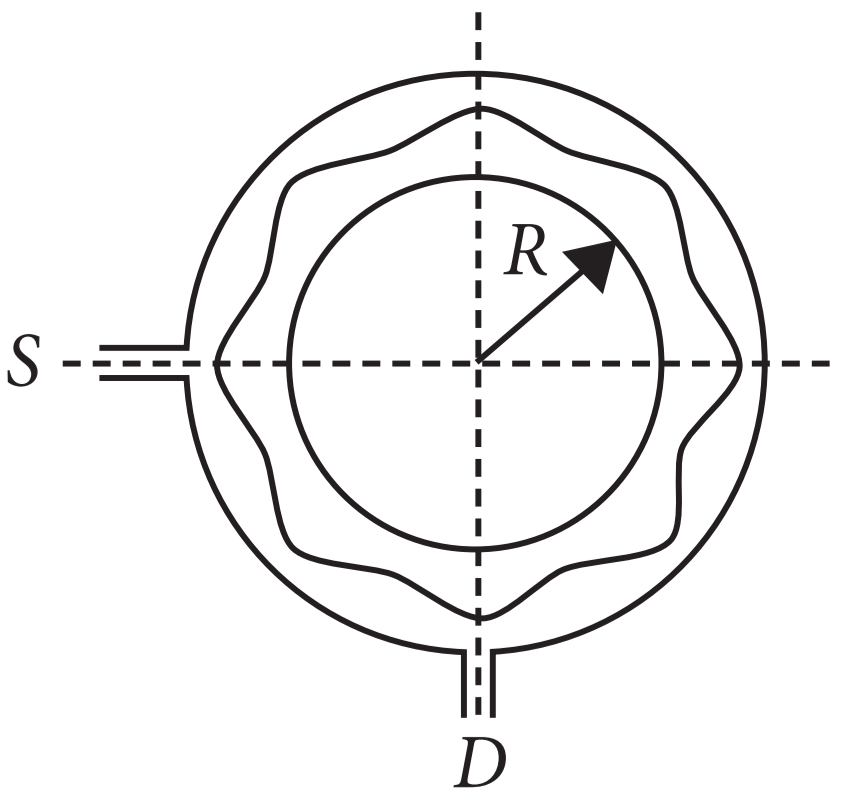
A narrow tube is bent in the form of a circle of radius R, as shown in figure. Two small holes S and D are made in the tube at the positions at right angle to each other. A source placed at S generates a wave of intensity $I_0$ which is equally divided into two parts: one part travels along the longer path, while the other travels along the shorter path. Both the waves meet at point Dwhere a detector is place
  1. If a maxima is formed at a detector, then the magnitude of wavelength $\lambda$ of the wave produced is given by:
  1. $\pi\text{R}$
  2. $\frac{\pi\text{R}}{2}$
  3. $\frac{\pi\text{R}}{4}$
  4. All of these.
  1. If the in tensity ratio of two coherent sources used in Young's double slit experiment is 49 : 1, then the ratio between the maximum and minimum intensities in the interference pattern is:
  1. $1 : 9$
  2. $9 : 16$
  3. $25 : 16$
  4. $16 : 9$
  1. The maximum intensity produced at D is given by:
  1. $4I_0$
  2. $2I_0$
  3. $I_0$
  4. $3I_0$
  1. ln a Young's double slit experiment, the intensity at a point where the path difference is $\frac{\lambda}{6}$ ($\lambda$ - wavelength of the light) is I. If $I_0$ denotes the maximum intensity, then $I/I_0$ is equal to:
  1. $\frac{1}{2}$
  2. $\frac{\sqrt3}{2}$
  3. $\frac{1}{\sqrt2}$
  4. $\frac{3}{4}$
  1. Two identical light waves, propagating in the same direction, have a phase differenced. After they superpose the intensity of the resulting wave will be proportional to:
  1. $\cos\delta$
  2. $\cos\Big(\frac{\delta}{2}\Big)$
  3. $\cos^2\Big(\frac{\delta}{2}\Big)$
  4. $\cos^2\delta$
A magnetic needle is free to rotate in a vertical plane which makes an angle of 60° with the magnetic meridian. If the needle stays in a direction making an angle of $\tan^{-1}\Big(\frac{2}{\sqrt{3}}\Big)$ with the horizontal, what would be the dip at that place?
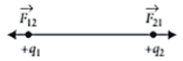
Coulomb's law states that the electrostatic force of attraction or repulsion acting between two stationary point charges is given by
Image

where $F$ denotes the force between two charges $q _1$ and $q _2$ separated by a distance $r$ in free space, $\varepsilon_0$ is a constant known as the permittivity of free space. Free space is a vacuum and may be taken to be air practically. If free space is replaced by a medium, then $\varepsilon_0$ is replaced by $\left(\varepsilon_0 k\right)$ or $\left(\varepsilon_0 \varepsilon_r\right)$ where $k$ is known as dielectric constant or relative permittivity.
$(i)$ In coulomb's law, $F =k \frac{q_1 q_2}{r^2}$, then on which of the following factors does the proportionality constant $k$ depends?
$(a)$ Nature of the medium between the two charges
$(b)$ Distance between the two charges
$(c)$ Electrostatic force acting between the two charges
$(d)$ Magnitude of the two charges
$(ii)$ Dimensional formula for the permittivity constant $\varepsilon_0$ of free space is
$(a) \left[ M ^{-1} L^3 T^2 A^2\right]$
$(b) \left[ ML ^{-3} T^4 A^2\right]$
$(c) \left[ M ^{-1} L^{-3} T^4 A^2\right]$
$(d) \left[ ML ^{-3} T^4 A^{-2}\right]$
$(iii)$ The force of repulsion between two charges of $1 C$ each, kept $1m$ apart in vaccum is
$(a) \frac{1}{9 \times 10^9} N$
$(b) \frac{1}{9 \times 10^{12}} N$
$(c) 9 \times 10^7 N$
$(d) 9 \times 10^9 N$
$(iv)$ Two identical charges repel each other with a force equal to $10$ mgwt when they are $0.6 m$ apart in air.
$(g =10 m s ^{-2} ).$ The value of each charge is
$(a) 2 mC$
$(b) 2 \times 10^{-7} mC$
$(c) 2 \mu C$
$(d) 2 nC$
OR
Coulomb's law for the force between electric charges most closely resembles with
$(a)$ law of conservation of energy
$(b)$ Newton's $2^{nd}$ law of motion
$(c)$ law of conservation of charge .
$(d)$ Newton's law of gravitation