MCQ
If an electron is transferred from $B$ to $A$ , then reaction is possible when
- A$(I.E_A - E.A_B) < (I.E_B - E.A_A)$
- B$(I.E_B + E.A_B) > (I.E_A - E.A_A)$
- ✓$(I .E_B + E.A_B ) < (I.E_A + E.A_A)$
- D$(I.E_B - E.A_B) < (I.E_A - E.A_A)$
Generate a complete, print-ready paper with questions like this in minutes — across 16+ boards, with answer keys.
$2K\,Cl{O_3}\xrightarrow{{}}2KCl + 3{O_2}$ law of mass action
$H_2C = CH - CH_2 - I \xrightarrow[CC{{l}_{4}}]{HI(excess)}$
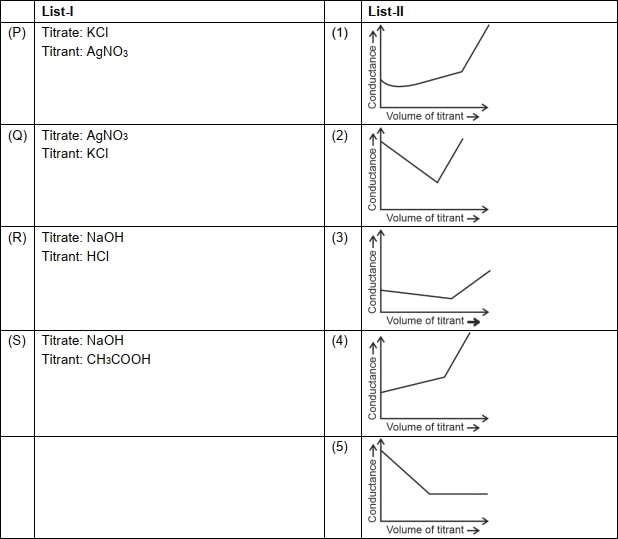
The limiting ionic conductivity ( $\Lambda 0$ ) values (in $mS m ^2 mol ^{-1}$ ) for different ions in aqueous solutions are given below:
| Ions | $Ag ^{+}$ | $K ^{+}$ | $Na ^{+}$ | $H ^{+}$ | $NO _3^{-}$ | $CI ^{-}$ | $SO _4^{2-}$ | $OH ^{-}$ | $CH_3COO ^{-}$ |
| $\Lambda_0$ | $6.2$ | $7.4$ | $5.0$ | $35.0$ | $7.2$ | $7.6$ | $16.0$ | $19.9$ | $4.1$ |
For different combinations of titrates and titrants given in $List-l$, the graphs of 'conductance' versus 'volume of titrant' are given in $List-II$.
Match each entry in $List-I$ with the appropriate entry in $List-II$ and choose the correct option.