Question
If an element has 22 electrons then what will be its atomic number?

Answer

  1. 22
Explanation:
Atomic number of any element is equal no of electron.
Atomic no. = no. of proton = no of electron.

Need a full question paper?

Generate a complete, print-ready paper with questions like this in minutes — across 16+ boards, with answer keys.
Start Generating Free

Similar questions

The two bulbs as in the above question are connected in series to a 200 volt line. Then(a) The potential drop across the two bulbs is the same(b) The potential drop across the 40 watt bulb is greater than the potential drop across the 100 watt bulb(c) The potential drop across the 100 W bulb is greater than the potential drop across the 40 W bulb(d) The potential drop across both the bulb is 200 volt


A galvanometer is converted into ammeter by adding :
A sinusoidal voltage $\text{V}=200\sin314\text{t}$ is applied to a $10\Omega$ resistor. Find the peak voltage.
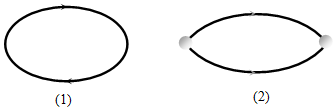
Below figures $(1)$ and $(2)$ represent lines of force. Which is correct statement
When a piece of a ferromagnetic substance is put in a uniform magnetic field, the flux density inside it is four times the flux density away from the piece. The magnetic permeability of the material is(a) 1(b) 2(c) 3(d) 4
       
A straight wire carrying current $i$ is turned into a circular loop. If the magnitude of magnetic moment associated with it in $\text{M.K.S.}$ unit is $M,$ the length of wire will be
Energy stored in electromagnetic oscillations is in the form of(a) Electrical energy(b) Magnetic energy(c) Both (a) and (b)(d) None of these
       
Direction of force due to magnetic field on a moving charged particle is:
  1. Perpendicular to direction of velocity of charged particle.
  2. Perpendicular to direction of magnetic field.
  3. Parallel to direction of velocity of charged particle.
  4. Parallel to the direction of magnetic field.
Correct statements are.
The shortest wavelength of X-rays emitted from an X-ray tube depends on the(a) Current in the tube(b) Voltage applied to the tube(c) Nature of gas in the tube(d) Atomic number of target material
   
   
A point object is placed at a distance of 30cm from a convex mirror of focal length 30cm. The image will form at: