Question
If $A^T=\left[\begin{array}{rr}3 & 4 \\ -1 & 2 \\ 0 & 1\end{array}\right]$ and $B=\left[\begin{array}{rrr}-1 & 2 & 1 \\ 1 & 2 & 3\end{array}\right]$, then find $A^T-B^T$.

Answer

(a) : $B^T=\left[\begin{array}{rr}-1 & 1 \\ 2 & 2 \\ 1 & 3\end{array}\right]$
So, $\quad A^T-B^T=\left[\begin{array}{cc}3 & 4 \\ -1 & 2 \\ 0 & 1\end{array}\right]-\left[\begin{array}{cc}-1 & 1 \\ 2 & 2 \\ 1 & 3\end{array}\right]=\left[\begin{array}{cc}4 & 3 \\ -3 & 0 \\ -1 & -2\end{array}\right]$

Need a full question paper?

Generate a complete, print-ready paper with questions like this in minutes — across 16+ boards, with answer keys.
Start Generating Free

Similar questions

$\big[\vec{\text{a}}\vec{\text{b}}\vec{\text{a}}\times\vec{\text{b}}\big]+\big(\vec{\text{a}}.\vec{\text{b}}\big)^2=$
  1. $\big|\vec{\text{a}}\big|^2\big|\vec{\text{b}}\big|^2$
  2. $\big|\vec{\text{a}}+\vec{\text{b}}\big|^2$
  3. $\big|\vec{\text{a}}\big|^2+\big|\vec{\text{b}}\big|^2$
  4. $2\big|\vec{\text{a}}\big|^2\big|\vec{\text{b}}\big|^2$
Minimize $Z=5 x+10$ y subject to $x+2 y \leq 120, x+y \geq 60, x-2 y \geq 0, x, y \geq 0$
Direction ratio of line joining (2, 3, 4) and (-1, -2, 1), are:
  1. (-3, -5, -3)
  2. (-3, 1, -3)
  3. (-1, -5, -3)
  4. (-3, -5, 5)
Objective function of a LPP is:
  1. a constraint
  2. a function to be optimized
  3. a relation between the variables
  4. none of these
Let $\text{f(x)}=\frac{\text{x}-1}{\text{x}+1},$ then f(f(x)) is:
  1. $\frac{1}{\text{x}}$
  2. $-\frac{1}{\text{x}}$
  3. $\frac{1}{\text{x}+1}$
  4. $\frac{1}{\text{x}-1}$
The area of the region bounded by the parabola $(y - 2)^2 = x - 1,$ the tangent to it at the point with the ordinate $3$ and the $x-$axis is:
Let R be the relation over the set of all straight lines in a plane such that  $\text{l}_1\text{Rl}_2\Leftrightarrow\text{l}_1\bot\text{l}_2.$ Then, R is:
  1. Symmetric.
  2. Reflexive.
  3. Transitive.
  4. An equivalence relation.
Choose the correct answer in Exercises:
The anti derivative of $\bigg(\sqrt{\text{x}}+\frac{1}{\sqrt{\text{x}}}\bigg)$equals
  1. $\frac{1}{3}\text{x}^{\frac{1}{3}}+2\text{x}^{\frac{1}{2}}+\text{c}$
  2. $\frac{2}{3}\text{x}^{\frac{2}{3}}+\frac{1}{2}\text{x}^2+\text{c}$
  3. $\frac{2}{3}\text{x}^{\frac{3}{2}}+2\text{x}^{\frac{1}{2}}+\text{c}$
  4. $\frac{3}{2}\text{x}^{\frac{3}{2}}+\frac{1}{2}\text{x}^{\frac{1}{2}}+\text{c}$
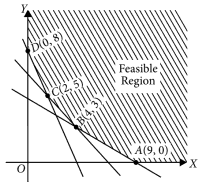
Feasible region for an L.P.P. is shown shaded in the following figure. Minimum of $Z=4 x+3 y$ occurs at the point
Image
If $\text{f(x)}=\begin{cases}\frac{\log(1+\text{ax})-\log(1-\text{bx})}{\text{x}},&\text{x}\neq0\\\text{k},&\text{x}=0\end{cases}$ and f(x) is continous at x = 0, then the value of k is:
  1. a - b
  2. a + b
  3. $\log\text{a}+\log\text{b}$
  4. none of these