MCQ
If body having initial velocity zero is moving with uniform acceleration $8\,\,m/{\sec ^2}$ the distance travelled by it in fifth second will be.........$metres$
  • $36$
  • B
    $40$
  • C
    $100$
  • D
    $0$

Answer

Correct option: A.
$36$
a
(a) Distance travelled in ${n^{th}}$ second $ = u + \frac{a}{2}(2n - 1)$

Distance travelled in ${5^{th}}$ second

$ = 0 + \frac{8}{2}\left( {2 \times 5 - 1} \right)$

$=36\,m$

Need a full question paper?

Generate a complete, print-ready paper with questions like this in minutes — across 16+ boards, with answer keys.
Start Generating Free

Similar questions

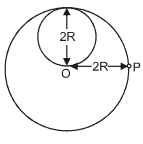
A lamina is made by removing a small disc of diameter $2 \ R$ from a bigger disc of uniform mass density and radius $2 \ R$, as shown in the figure. The moment of inertia of this lamina about axes passing through $O$ and $P$ is $I _0$ and $I _{ p }$, respectively. Both these axes are perpendicular to the plane of the lamina. The ratio $\frac{ I _{ P }}{ I _0}$ to the nearest integer is:
The heat capacity of one mole an ideal is found to be $C_V=3 R(1+a R T) / 2$, where $a$ is a constant. The equation obeyed by this gas during a reversible adiabatic expansion is
A stone is projected from the ground with velocity $25\,m/s$. Two seconds later, it just clears a wall $5 \,m$ high. The angle of projection of the stone is ........ $^o$ $(g = 10m/{\sec ^2})$
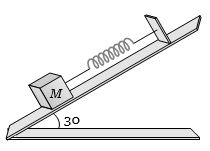
A body of mass $5\,kg$ is suspended by a spring balance on an inclined plane as shown in figure. The spring balance measure ............ $N$
Which one of the following does not represent a travelling wave
A bomb of mass $12\,\,kg$  at rest explodes into two fragments of masses in the ratio $1 : 3.$  The $K.E.$  of the smaller fragment is $216\,\,J.$  The momentulm of heavier fragment is (in $kg-m/sec$ )
Which of the following systems of units is not based on units of mass, length and time alone?
For the given vector $\vec A =3\hat i -4\hat j+10\hat k$ , the ratio of magnitude of its component on the $x-y$ plane and the component on $z-$ axis is
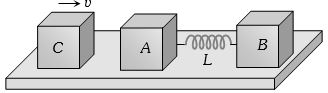
Two blocks $A$ and $B$ each of mass m are connected by a massless spring of natural length L and spring constant $K$. The blocks are initially resting on a smooth horizontal floor with the spring at its natural length as shown in figure. A third identical block $C$ also of mass $m$ moves on the floor with a speed $v$ along the line joining $A$ and $B$ and collides with $A$. Then
During an adiabatic compression, $830\, J$ of work is done on $2\, moles$ of a diatomic ideal gas to reduce its volume by $50\%$. The change in its temperahture is nearly..... $K$ $(R\, = 8.3\, J\,K^{-1}\, mol^{-1} )$