Question
If $e^y= y^x,$ prove that $\frac{\text{dy}}{\text{dx}}=\frac{(\log\text{y})^2}{\log\text{y}-1}$
Answer

We have, $e^y = y^x$
Taking log on both sides,
$\log\text{e}^{\text{y}}=\log\text{y}^\text{x}$
$\Rightarrow\text{y}\log\text{e}=\text{x}\log\text{y}$
$\Rightarrow\text{y}=\text{x}\log\text{y}\ .....(\text{i})$
Differentiating with respect to $x,$
$\frac{\text{dy}}{\text{dx}}=\frac{\text{d}}{\text{dx}}(\text{x}\log\text{y})$
$\Rightarrow\frac{\text{dy}}{\text{dx}}=\text{x}\frac{\text{dy}}{\text{dx}}(\log\text{y})+\log\text{y}\frac{\text{d}}{\text{dx}}(\text{x})$
$\Rightarrow\frac{\text{dy}}{\text{dx}}=\frac{\text{x}}{\text{y}}\frac{\text{dy}}{\text{dx}}+\log\text{y}$
$\Rightarrow\frac{\text{dy}}{\text{dx}}\Big(1-\frac{\text{x}}{\text{y}}\Big)=\log\text{y}$
$\Rightarrow\frac{\text{dy}}{\text{dx}}\big(\frac{\text{y}-\text{x}}{\text{y}}\big)=\log\text{y}$
$\Rightarrow\frac{\text{dy}}{\text{dx}}=\frac{\text{y}\log\text{y}}{\text{y}-\text{x}}$
$\Rightarrow\frac{\text{y}\log\text{y}}{\Big(\text{y}-\frac{\text{y}}{\log\text{y}}\Big)}$
$[$Using equation $(i)]$
$\Rightarrow\frac{\text{dy}}{\text{dx}}=\frac{\text{y}\log\text{y}(\log\text{y})}{\text{y}\log\text{y}-\text{y}}$
$\Rightarrow\frac{\text{dy}}{\text{dx}}=\frac{\text{y}(\log\text{y})^2}{\text{y}(\log\text{y}-1)}$
$\Rightarrow\frac{\text{dy}}{\text{dx}}=\frac{(\log\text{y})^2}{(\log\text{y}-1)}$

Need a full question paper?

Generate a complete, print-ready paper with questions like this in minutes — across 16+ boards, with answer keys.

Start Generating Free

Similar questions

$\text{If A} = \begin{bmatrix}3&1\\-1&2\end{bmatrix},$ show that $A^2 - 5A + 7I = 0$. Hence find $A^{-1}.$
Verify Rolle's theorem for the following function on the indicated intervals $f(x) = x^2+ 5 x + 6$ on the interval $[-3, -2]$ 
Evaluate the following integrals:
$\int\limits^{\frac{\pi}{2}}_{0}\sqrt{\cos\text{x}-\cos^3\text{x}}(\sec^3\text{x}-1)\cos^2\text{x dx}$
Prove that the curves $y^2 = 4x$ and $x^2 + y^2 - 6x + 1 = 0$ touch each other at the point $(1, 2).$
On a multiple choice examination with three possible answers (out of which only one is correct) fo each of the five questions, what is the probability that a candidate would get four or more correct answers just by guessing?
The slope of the tangent at a point P(x, y) on a curve is $\frac{-\text{x}}{\text{y}}$. If the curve passs es through the point (3, -4). Find the equation of the curve.
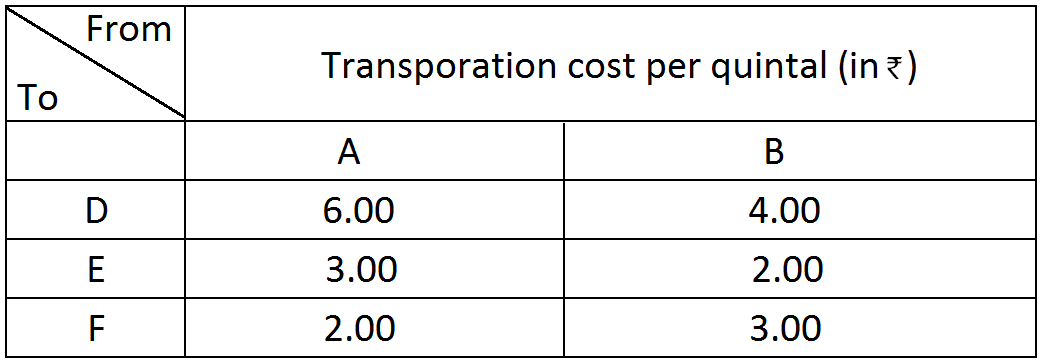
Tow godowns$, A$ and $B,$ have grain storage capacity of $100$ quintals and $50$ quintals respectively. They supply to $3$ ration shops$, D, E$ and $F,$ whose requirements are $60, 50$ and $40$ quintals respectively. The cost of transportation per quintal from the godowns to the shops are given in the following table:

How should the supplies be transported in order that the transportation cost is minimum? 
Let A be the set of all human beings in a town at a particular time. Determine whether the following relations are reflexive, symmetric and transitive:
R = {(x, y): x and y work at the same place}
Find the vector equation of the line passing through $(1, 2, 3)$ and parallel to the planes $\vec{\text{r}}\cdot(\hat{\text{i}}-\hat{\text{j}}+2\hat{\text{k}})=5$ and $\vec{\text{r}}\cdot(3\hat{\text{i}}+\hat{\text{j}}+\hat{\text{k}})=6.$ 
Suppose 10,000 tickets are sold in a lottery each for Rs. 1. First prize is of Rs. 3000 and the second prize is of Rs. 2000. There are three third prizes of Rs. 500 each. If you buy one ticket, what is your expectation.