Question
If f(2a - x) = -f(x), prove that $\int\limits^{2\text{a}}_0\text{f(x)}\text{dx}=0$

Answer

Let $\text{I}=\int\limits^{2\text{a}}_0\text{f(x)}\text{dx}=0$
Using additive property
$\text{I}=\int\limits^{\text{a}}_0\text{f(x)}\text{dx}+\int\limits^{2\text{a}}_0\text{f(x)}\text{dx}$
Consider the integral $\int\limits^{2\text{a}}_0\text{f(x)}\text{dx}$
Let $\text{x}=2\text{a}-\text{t},$ Then $\text{dx}=-\text{dt}$
When $\text{x}=\text{a},\text{t}=\text{a}$ and $\text{x}=2\text{a},\text{t}=0$
Threrfore,
$=\int\limits^{2\text{a}}_0\text{f(x)}\text{dx}=-\int\limits^0_\text{a}\text{f}(2\text{a}-\text{t})\text{dt}$
$=\int\limits^\text{a}_0\text{f}(2\text{a}-\text{t})\text{dt}$
$=\int\limits^\text{a}_0\text{f}(2\text{a}-\text{x})\text{dx}$ (Chang ing the variable)
We have
$\text{f}(2\text{a}-\text{x})=-\text{f(x)}$
Therefore,
$\text{I}=\int\limits^\text{a}_0\text{f(x)}\text{dx}-\int\limits^\text{a}_0\text{f(x)}\text{dx}=0$ 

Need a full question paper?

Generate a complete, print-ready paper with questions like this in minutes — across 16+ boards, with answer keys.
Start Generating Free

Similar questions

Find the area of the region in the first quadrant enclosed by the x-axis, the line y = x and the circle x2+ y2 = 32.
A kite is moving horizontally at a height of 151.5 meters. If the speed of kite is 10m/ s, how fast is the string being let out; when the kite is 250m away from the boy who is flying the kite? The height of boy is 1.5m.
$\text{Evaluate:} \int\limits_0^\frac{\pi}{2} (2\log \sin \text{x} - \log \sin 2\text{x}) \text{dx}$
There are two types of fertilisers 'A' and 'B'. 'A' consists of 12% nitrogen and 5% phosphoric acid whereas 'B' consists of 4% nitrogen and 5% phosphoric acid. After testing the soil conditions, farmer finds that he needs at least 12kg of nitrogen and 12kg of phosphoric acid for his crops. If 'A' costs Rs. 10 per kg and 'B' cost Rs. 8 per kg, then graphically determine how much of each type of fertiliser should be used so that nutrient requiremnets are met at a minimum cost.
Find the general solution of the differential equation
$\text{x}\log\text{x}.\frac{\text{dy}}{\text{dx}}+\text{y}=\frac{2}{\text{x}}\cdot\log\text{x}$.
Solve the following determinant equations:
$\begin{vmatrix}1&1&\text{x}\\\text{p}+1&\text{p}+1&\text{p}+\text{x}\\3&\text{x}+1&\text{x}+2\end{vmatrix}=0$
A card from a pack of 52 cards is lost. From the remaining cards of the pack, two cards are drawn at random and are found to both clubs. Find the probability of the lost card being of clubs.
Prove that the lines through A(0, -1, -1) and B(4, 5, 1) intersects the line through C(3, 9, 4) and D(-4, 4, 4). Also, find their point of intersection.
Using integration, find the area of the region in the first quadrant enclosed by the x-axis, the line y = x and the circle x2 + y2 = 32.
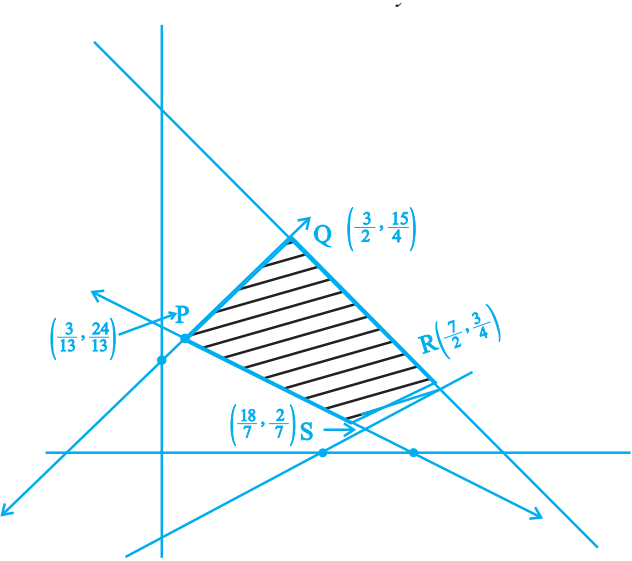
In the feasible region (shaded) for a LPP is shown. Determine the maximum and minimum value of Z = x + 2y.