Question
If $\frac{4}{5}$, $a, 2$ are three consecutive terms of an A.P.?

Answer

Here, we are given three consecutive terms of an A.P.
First term $(a_1)$ = $\frac{4}{5}$
Second term $(a_2) = a$
Third term $(a_3) = 2$
We need to find the value of a. So, in an A.P. the difference of two adjacent terms is always constant. So, we get,
$d = a_2 - a_1$​​​​​​​
$\text{d}=\text{a}-\frac{4}{5}\ ....\text{(i)}$
Also,
$d = a_3 - a_2$
$d = 2 - a$
Now, on equating (i) and (ii), we get,
$\text{a}-\frac{4}{5}=2-\text{a}$
$\text{a}+\text{a}=2+\frac{4}{5}$
$2\text{a}=\frac{10+4}{5}$
$\text{a}=\frac{14}{10}$
$\text{a}=\frac{7}{5}$
Therefore, $\text{a}=\frac{7}{5}$.

Need a full question paper?

Generate a complete, print-ready paper with questions like this in minutes — across 16+ boards, with answer keys.

Start Generating Free

Similar questions

Five coins were simultaneously tossed 1000 times and at each toss the number of heads were observed. The number of tosses during which 0, 1, 2, 3, 4 and 5 heads were obtained are shown in the table below. Find the mean number of heads per toss:
No of head per toss No. of tosses
0 38
1 144
2 342
3 287
4 164
5 25
Total 1000
In a school the weekly pocket money of 50 students is as follows. Find mode of pocket money.

Pocket money (in ₹)

40 – 50

50 – 60

60 – 70

70 – 80

80 – 90

90 – 100

No. of students

2

8

12

14

8

6

The marks scored by 750 students in an examination are given in the form of a frequency distribution table:
Marks
No. of students
600-640
16
640-680
45
680-720
156
720-760
284
760-800
172
800-840
59
840-880
18
Prepare a cumulative frequency table by less than method and
draw on ogive.
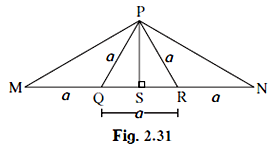
From the information given in the figure 2.31, prove that PM = PN = $\sqrt3 \times a$
Find the radius of a circle whose perimeterter and are are numerically equal.
Two cones have their heights in the ratio 1 : 3 and radii 3 : 1. What is the ratio of their volumes?
Prove that the points A(1, 7), B(4, 2), C(-1, -1) D(-4, 4) are the vertices of a square.
Find the value of k for which the following systems of equations has unique solution:
$4x - 5y = k, 2x - 3y = 12$
For the following, find a quadratic polynomial whose sum and product respectively of the zeroes are as given. Also, find the zeroes of these polynomials by factorization.
$-2\sqrt{3},-9$
Using prime factorization, find the HCF and LCM of:
$144, 198$