MCQ
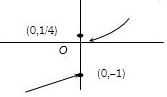
If $f(x) = \left\{ \begin{array}{l}x - 1,\,\,\,x < 0\\\,\,\,\,\,\,\frac{1}{4},\,\,x = 0\\\,\,\,\,\,\,\,{x^2},\,\,x > 0\end{array} \right.$, then
  • A
    $\mathop {\lim }\limits_{x \to 0 + } f(x) = 1$
  • B
    $\mathop {\lim }\limits_{x \to 0 - } f(x) = 1$
  • C
    $f(x)$ is discontinuous at $x = 0$
  • D
    None of these

Answer

Clearly from curve drawn of the given function $f(x)$ is discontinuous at $x = 0.$

Need a full question paper?

Generate a complete, print-ready paper with questions like this in minutes — across 16+ boards, with answer keys.

Start Generating Free

Similar questions

Let a circle $C$ in complex plane pass tltrough the points $z _{1}=3+4 i , z _{2}=4+3 i$ and $z _{3}=5 i$. If $z \left(\neq z _{1}\right)$ is a point on $C$ such that the line through $z$ and $z _{1}$ is perpendicular to the line through $z _{2}$ and $z _{3}$, then $\arg ( z )$ is equal to
Let $\vec{\alpha}=4 \hat{ i }+3 \hat{ j }+5 \hat{ k }$ and $\vec{\beta}=\hat{ i }+2 \hat{ j }-4 \hat{ k }$. Let $\vec{\beta}_1$ be parallel to $\vec{\alpha}$ and $\vec{\beta}_2$ be perpendicular to $\vec{\alpha}$. If $\vec{\beta}=\vec{\beta}_1+\vec{\beta}_2$, then the value of $5 \vec{\beta}_2 \cdot(\hat{ i }+\hat{ j }+\hat{ k })$ is
The houses on one side of a road are numbered using consecutive even numbers. The sum of the numbers of all the houses in that row is $170$ . If there are at least $6$ houses in that row and $a$ is the number of the sixth house, then
If $A = \left\{ {z:\left| {\frac{{z - 2}}{{z + 2}}} \right| = 3,z \in C} \right\}$ and ${z_1},\,{z_2},\,{z_3},\,{z_4} \in A$ are $4$ complex numbers representing points $P,\, Q,\, R, S$ respectively on the complex plane such that ${z_1} - {z_2} = {z_4} - {z_3}$ , then maximum value of area of quadrilateral $PQRS$ is 
Value of the definite integral $\int\limits_{ - 3}^1 {(2{{\left( {t + 1} \right)}^5} - 5{{\left( {t + 1} \right)}^3} + t + 3} {)dt}$ is equal to
The number of all $2-$digit numbers $n$, such that $n$ is equal to the sum of the square of digit in its tens place and the cube of the digit in units place is
For any $3 \times 3$ matrix $M$, let $| M |$ denote the determinant of $M$. Let

$E=\left[\begin{array}{ccc}1 & 2 & 3 \\ 2 & 3 & 4 \\ 8 & 13 & 18\end{array}\right], P=\left[\begin{array}{lll}1 & 0 & 0 \\ 0 & 0 & 1 \\ 0 & 1 & 0\end{array}\right]$ and $F=\left[\begin{array}{ccc}1 & 3 & 2 \\ 8 & 18 & 13 \\ 2 & 4 & 3\end{array}\right]$

If $Q$ is a nonsingular matrix of order $3 \times 3$, then which of the following statements is (are) $TRUE$?

$(A)$F $=P E P$ and $P^2=\left[\begin{array}{lll}1 & 0 & 0 \\ 0 & 1 & 0 \\ 0 & 0 & 1\end{array}\right]$

$(B)$ $\left| EQ + PFQ ^{-1}\right|=| EQ |+\left| PFQ ^{-1}\right|$

$(C)$ $\left|( EF )^3\right|>| EF |^2$

$(D)$ Sum of the diagonal entries of $P ^{-1} EP + F$ is equal to the sum of diagonal entries of $E + P ^{-1} FP$
The image of the point $(3,5)$ in the line $x-y+1=0$, lies on
Let $\vec{a}, \vec{b}, \vec{c}$ be three mutually perpendicular vectors of the same magnitude and equally inclined at an angle $\theta$, with the vector $\vec{a}+\vec{b}+\vec{c}$. Then $36 \cos ^{2} 2 \theta$ is equal to $.....$
Let the latus rectum of the hyperbola $\frac{x^2}{9}-\frac{y^2}{b^2}=1$ subtend an angle of $\frac{\pi}{3}$ at the centre of the hyperbola. If $\mathrm{b}^2$ is equal to $\frac{l}{\mathrm{~m}}(1+\sqrt{\mathrm{n}})$, where $l$ and $\mathrm{m}$ are co-prime numbers, then $l^2+\mathrm{m}^2+\mathrm{n}^2$ is equal to______________.