MCQ
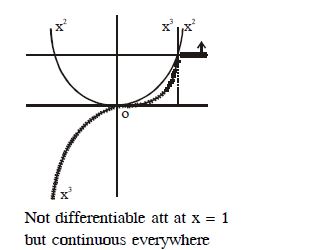
If $f(x)\ =$ min. $\{1, x^2, x^3\},$ then
  • A
    $f(x)$ is discontinuous $\forall \,x\, \in \,R$
  • B
    $f(x) > 0$  $\forall \,x\, \in \,R$
  • $f(x)$ is not differentiable but continuous $\forall \,x\, \in \,R$
  • D
    $f(x)$ is not differentiable for two values of $x$
Answer

Correct option: C.
$f(x)$ is not differentiable but continuous $\forall \,x\, \in \,R$
c

Need a full question paper?

Generate a complete, print-ready paper with questions like this in minutes — across 16+ boards, with answer keys.

Start Generating Free

Similar questions

If X is a random variable with probability distribution as given below:

X = xi 0 1 2 3
P(X = Xi) k 3k 3k k

The value of k and its variance are:

  1. $\frac{1}{8},\frac{22}{27}$

  2. $\frac{1}{8},\frac{23}{27}$

  3. $\frac{1}{8},\frac{24}{27}$

  4. $\frac{1}{8},\frac{3}{4}$

If A, B are two n × n non-singular matrices, then
  1. AB is non-singular.
  2. AB is singular.
  3. (AB)-1 A-1 B-1.
  4. (AB)-1 does not exist.
Z = 8x + 10y, subject to $2\text{x}+\text{y}\geq1,2\text{x}+3\text{y}\geq15,\text{y}\geq2,\text{x}\geq0,\text{y}\geq0.$ The minimum value of Z occurs at.
  1. (4.5, 2)
  2. (1.5, 4)
  3. (0, 7)
  4. (7, 0)
Which of the following is not correct in a given determinant of A, where A = [aij]3×3:
  1. Order of minor is less than order of the det (A).
  2. Minor of an element can never be equal to cofactor of the same element.
  3. Value of determinant is obtained by multiplying elements of a row or column by corresponding cofactors.
  4. Order of minors and cofactors of elements of A is same.
Match the statements/expressions in Column $I$ with the open intervals in Column $II$.

Column $I$ Column $II$
$(A)$ Interval contained in the domain of definition of non-zero solutions of the differential equation $(x-3)^2 y^{\prime}+y=0$ $(p)$ $\left(-\frac{\pi}{2}, \frac{\pi}{2}\right)$

$(B)$ Interval containing the value of the integral

$\int_1^5(x-1)(x-2)(x-3)(x-4)(x-5) d x$

$(q)$ $\left(0, \frac{\pi}{2}\right)$
$(C)$ Interval in which at least one of the points of local maximum of $\cos ^2 x+\sin x$ lies $(r)$ $\left(\frac{\pi}{8}, \frac{5 \pi}{4}\right)$
$(D)$ Interval in which $\tan ^{-1}(\sin x+\cos x)$ is increasing $(s)$ $\left(0, \frac{\pi}{8}\right)$
  $(t)$ $(-\pi, \pi)$
Two events A and B will be independent, if

  1. A and B are mutually exclusive

  2. $\text{P}(\text{A}'\text{B}')=\big[1-\text{P}(\text{A})\big]\big[1-\text{P}(\text{B})\big]$

  3. P(A) = P(B)

  4. P(A) + P(B) = 1

If $A=\left[\begin{array}{cc}1 & 5 \\ \lambda & 10\end{array}\right], A ^{-1}=\alpha A+\beta I$ and $\alpha+\beta=-2$ then $4 \alpha^2+\beta^2+\lambda^2$ is equal to:
If the solution curve of the differential equation $\left(2 x-10 y^{3}\right) d y+y d x=0$, passes through the points $(0,1)$ and $(2, \beta)$, then $\beta$ is a root of the equation:
If P(A) + P(B) = 1; then which of the following option explains the event A and B correctly?
Area lying between the curves y2 = 4x and y = 2x is:
  1. $\frac{2}{3}$
  2. $\frac{1}{3}$
  3. $\frac{1}{4}$
  4. $\frac{3}{4}$