MCQ
If $f(x) = \sqrt {\frac{{x - \sin x}}{{x + {{\cos }^2}x}}} $, then $\mathop {\lim }\limits_{x \to \infty } f(x)$is
  • A
    $0$
  • B
    $\infty $
  • $1$
  • D
    None of these

Answer

Correct option: C.
$1$
c
(c) $\mathop {\lim }\limits_{x \to \infty } \,\,f(x) = \,\mathop {\lim }\limits_{x \to \infty } \,\sqrt {\frac{{x - \sin x}}{{x + {{\cos }^2}x}}} $

$= \mathop {\lim }\limits_{x \to \infty } \,\,\sqrt {\frac{{1 - \frac{{\sin x}}{x}}}{{1 + \frac{{{{\cos }^2}x}}{x}}}} $

$ = \sqrt {\frac{{1 - 0}}{{1 + 0}}} = 1$, 

$\left( {\because \,\,\,\frac{{\sin x}}{x} \to 0,\frac{{{{\cos }^2}x}}{x}\, \to 0\,\,{\text{as }}x \to \infty } \right)$.

Need a full question paper?

Generate a complete, print-ready paper with questions like this in minutes — across 16+ boards, with answer keys.
Start Generating Free

Similar questions

Let $x_1, x_2, \ldots, x_{11}$ be 11 distinct positive integers. If we replace the largest of these integers by the median of the other $10$ integers, then
Line through the points $(-2, 6)$ and $(4, 8)$ is perpendicular to the line through the points $(8, 12)$ and $(x, 24)$. Find the value of $x:$
${7^{th}}$ term of the sequence $\sqrt 2 ,\;\sqrt {10} ,\;5\sqrt 2 ,\;.......$ is
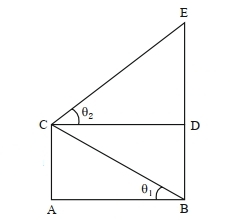
In the figure, $\theta_1+\theta_2=\frac{\pi}{2}$ and $\sqrt{3}(B E)=4(A B)$. If the area of $\triangle CAB$ is $2 \sqrt{3}-3$ unit $^2$, when $\frac{\theta_2}{\theta_1}$ is the largest, then the perimeter (in unit) of $\triangle CED$ is equal to $...........$.
The number of values of $k$ for which the equation ${x^2} - 3x + k = 0$has two real and distinct roots lying in the interval $(0, 1),$ are
The coefficient of $x - 7$ in the expansion of $\Big[\text{ax}2-\frac{1}{\text{bx}}^{2}\Big]11$ will be:
Let $a, b \in \mathbb{R}$ and $a^2+b^2 \neq 0$. Suppose $S=\left\{z \in \mathbb{C}: z=\frac{1}{a+i b t}, t \in \mathbb{R}, t \neq 0\right\}$, where $i=\sqrt{-1}$, If $z=x+i y$ and $z \in S$, then $(x, y)$ lies on

($A$) the circle with radius $\frac{1}{2 a}$ and centre $\left(\frac{1}{2 a}, 0\right)$ for $a>0, b \neq 0$

($B$) the circle with radius $-\frac{1}{2 a}$ and centre $\left(-\frac{1}{2 a}, 0\right)$ for $a<0, b ; 0$

($C$) the $x$-axis for $a \neq 0, b=0$

($D$) the $y$-axis for $a=0, b \neq 0$

Let $P$ be a set of squares, $Q$ be set of parallelograms, $R$ be a set of quadrilaterals and $S$ be a set of rectangles. Consider the following:
$1. \ce{P Ì Q}$
$2. \ce{R Ì P}$
$3. \ce{P Ì S}$
$4. \ce{S Ì R}$
Which of the above are correct?
 
There are $3$ sections in a question paper and each section contains $5$ questions. A candidate has to answer a total of $5$ questions, choosing at least one question from each section. Then the number of ways, in which the candidate can choose the questions, is
${\left( {\frac{{1 + i}}{{1 - i}}} \right)^2} + {\left( {\frac{{1 - i}}{{1 + i}}} \right)^2}$is equal to