MCQ
If $f(x) = {x^2} - 1$ and $g(x) = 3x + 1$, then $(gof)(x) = $
  • A
    ${x^2} - 1$
  • B
    $2{x^2} - 1$
  • $3{x^2} - 2$
  • D
    $2{x^2} + 2$

Answer

Correct option: C.
$3{x^2} - 2$
c
(c) $(gof)\,(x) = 3\,({x^2} - 1) + 1 = 3{x^2} - 2.$

Need a full question paper?

Generate a complete, print-ready paper with questions like this in minutes — across 16+ boards, with answer keys.
Start Generating Free

Similar questions

Integration of $\frac{1}{1+(\log_\text{e}\text{x})^2}$ with respect to $\log_\text{e}\text{x}$ is:
  1. $\frac{\tan^{-1}(\log_\text{e}\text{x})}{\text{x}}+\text{C}$
  2. $\tan^{-1}(\log_\text{e}\text{x})+\text{C}$
  3. $\frac{\tan^{-1}\text{x}}{\text{x}}+\text{C}$
  4. none of these
If $A = \left[ {\begin{array}{*{20}{c}}5&2\\3&1\end{array}} \right],$then ${A^{ - 1}}$=
Angle between vectors $\bar{a}=6 \hat{i}+2 \hat{j}-8 \hat{k}$ and $\bar{b}=4 \hat{i}-4 \hat{j}+2 \hat{k}$ is ___________ .
f : R → R given by $\text{f(x)}=\text{x}+\sqrt{\text{x}^2}$ is:
  1. Injective.
  2. Surjective.
  3. Bijective.
  4. None of these.
The solution of the differential equation ${x^2}\frac{{dy}}{{dx}} = {x^2} + xy + {y^2}$ is
Choose the correct answer from the given four options.
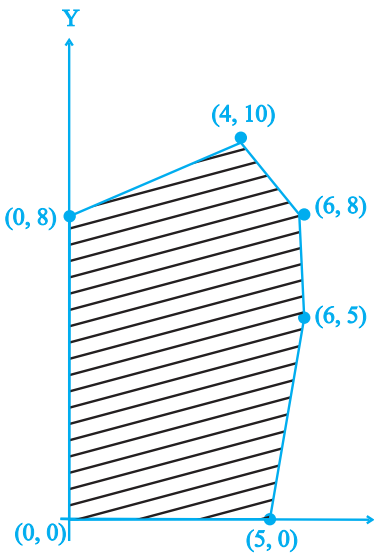
The feasible solution for a LPP is shown in. Let Z = 3x - 4y be the objective function.

Minimum of Z occurs at:
  1. (0, 0)
  2. (0, 8)
  3. (5, 0)
  4. (4, 10)
Choose the correct answer from the given four options.

Let f : R → R be the functions defined by f(x) = x3 + 5. Then f-1(x) is:

  1. $(\text{x}+5)^\frac{1}{3}$

  2. $(\text{x}-5)^\frac{1}{3}$

  3. $(5-\text{x})^\frac{1}{3}$

  4. $5-\text{x}$

If $\text{f(x)}=\text{x}^2+\frac{\text{x}^2}{1+\text{x}^2}+\frac{\text{x}^2}{(1+\text{x}^2)}+....+\frac{\text{x}^2}{(1+\text{x}^2)}+....,$ then at x = 0, f(x):
  1. Has not limit.
  2. Is discontinuous.
  3. Is continuous but not differentiable.
  4. Is differentiable.
If $\frac{{dy}}{{dx}} + \frac{3}{{{{\cos }^2}\,x}}\,y = \frac{1}{{{{\cos }^2}\,x}},$ $x \in \left( {\frac{{ - \pi }}{3},\frac{\pi }{3}} \right)$ and $y\left( {\frac{\pi }{4}} \right) = \frac{4}{3}$, then $y\left( { - \frac{\pi }{4}} \right)$ equals
If $f(x) = 2{x^6} + 3{x^4} + 4{x^2}$ then $f'(x)$ is