MCQ
If $f(x) = x^4+ \lambda x^3 +x^2$ $(\lambda \in R)$ has local maximum at $\frac{1}{2} ,$ then absolute minimum value of $f(x)$ is -
  • A
    $-4$
  • $0$
  • C
    $4$
  • D
    $-16$

Answer

Correct option: B.
$0$
b
$f^{\prime}(x)=4 x^{3}+3 \lambda x^{2}+2 x$

$\because f^{\prime}\left(\frac{1}{2}\right)=0 \Rightarrow \lambda=-2$

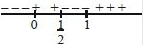
$\Rightarrow f^{\prime}(x)=2 x(2 x-1)(x-1)$

minimum value $=f(0)=f(1)=0$
Need a full question paper?

Generate a complete, print-ready paper with questions like this in minutes — across 16+ boards, with answer keys.
Start Generating Free

Similar questions

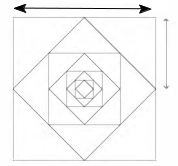
Let $S_1$ be the sum of areas of the squares whose sides are parallel to coordinate axes. Let $S_2$ be the sum of areas of the slanted squares as shown in the figure. Then, $\frac{S_1}{S_2}$ is equal to
$\int {\frac{{1 + x + \sqrt {x + {x^2}} }}{{\sqrt x \, + \sqrt {1 + x} }}\,\,dx = } $
The remainder on dividing $5^{99}$ by $11$ is
Let $f: R \rightarrow R$ be a twice differentiable function such that $(\sin x \cos y)(f(2 x+2 y)-f(2 x-2 y))=(\cos x$ $\sin y )(f(2 x +2 y )+f(2 x -2 y ))$, for all $x , y \in R$.
If $f^{\prime}(0)=\frac{1}{2}$, then the value of $24 f^{\prime \prime}\left(\frac{5 \pi}{3}\right)$ is:
Identify the correct order
Let $A=\{-3,-2,-1,0,1,2,3\}$ and R be a relation on A defined by $x R y$ if and only if $2 x-y \in\{0,1\}$. Let $l$ be the number of elements in R. Let m and n be the minimum number of elements required to be added in R to make it reflexive and symmetric relations, respectively. Then $l+ m$ $n$ is equal to :-
If for non-zero $x,$ $af(x) + bf\left( {\frac{1}{x}} \right) = \frac{1}{x} - 5,$ where $a \ne b,$ then $\int_1^2 {f(x)\,dx = } $
Let $S_n$ and  $s_n$ deontes the sum of first $n$ terms of two different $A.P$. for which $\frac{{{s_n}}}{{{S_n}}} = \frac{{3n - 13}}{{7n + 13}}$ then  $\frac{{{s_n}}}{{{S_{2n}}}}$
If $|x|<1,|y|<1$ and $x \neq y,$ then the sum to infinity of the following series $(x+y)+\left(x^{2}+x y+y^{2}\right)+\left(x^{3}+x^{2} y+x y^{2}+y^{3}\right)+\ldots .$
The value of the integral $\int\limits_{ - 2}^2 {\frac{{{{\sin }^2}\,x}}{{\left[ {\frac{x}{\pi }} \right] + \frac{1}{2}}}\,\,dx} $ (where $[x]$ denotes the greatest integer less than or equal to $x$ ) is