MCQ
If $f(x) = x{e^{x(1 - x)}}$, then $f(x)$ is
  • Increasing on $\left[ { - {1 \over 2},\,1} \right]$
  • B
    Decreasing on $ R$
  • C
    Increasing on $ R$
  • D
    Decreasing on $\left[ { - {1 \over 2},1} \right]$

Answer

Correct option: A.
Increasing on $\left[ { - {1 \over 2},\,1} \right]$
a
(a) $f'(x) = {e^{x(1 - x)}} + x.{e^{x(1 - x)}}.(1 - 2x)$

$ = \,\,{e^{x(1 - x)}}\{ 1 + x(1 - 2x)\} = {e^{x(1 - x)}}.( - 2{x^2} + x + 1)$

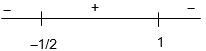
Now by the sign-scheme for $ - 2{x^2} + x + 1$

$f'(x) \ge 0,$ if $x\, \in \,\left[ { - \frac{1}{2},\,1} \right],$ because ${e^x}(1 - x)$ is always positive.

So, $f(x)$ is increasing on $\left[ { - \frac{1}{2},\,1} \right]$.
Need a full question paper?

Generate a complete, print-ready paper with questions like this in minutes — across 16+ boards, with answer keys.

Start Generating Free

Similar questions

A continuous and differentiable function $‘ f ‘$ satisfies the condition ,$\int\limits_0^x \, f (t) d t = f^2 (x) - 1$ for all real $‘ x ‘$. Then :
If $A$ and $B$ are two independent events with $P(A)=\frac{1}{3}$ and $P(B)=\frac{1}{4}$, then $P\left(B^{\prime} \mid A\right)$ is equal to
If $4\cos^{-1}\text{x}+\sin^{-1}\text{x}=\pi,$ then the value of x is:
  1. $\frac{3}{2}$
  2. $\frac{1}{\sqrt2}$
  3. $\frac{\sqrt3}{2}$
  4. $\frac{2}{\sqrt3}$
The maximum volume (in $cu.m$) of the right circular cone having slant height $3\, m$ is
The straigth line $\frac{\text{x}-3}{3}=\frac{\text{y}-2}{1}=\frac{\text{z}-1}{0}$ is:
  1. parallel to x-axis
  2. parallel to y-axis
  3. parallel to z-axis
  4. perpendicular to z-axis
If $S$ is the sum of the first $10$ terms of the series $\tan ^{-1}\left(\frac{1}{3}\right)+\tan ^{-1}\left(\frac{1}{7}\right)+\tan ^{-1}\left(\frac{1}{13}\right)+\tan ^{-1}\left(\frac{1}{21}\right)+\ldots$ then $\tan ( S )$ is equal to
$\int_{}^{} {\frac{{dx}}{{x + x\log x}} = } $
Let $\vec{a}=2 \hat{i}+\hat{j}-2 \hat{k}$ and $\vec{b}=\hat{i}+\hat{j} .$ If $\vec{c}$ is a vector such that $\vec{a} \cdot \vec{c}=|\vec{c}|,|\vec{c}-\vec{a}|=2 \sqrt{2}$ and the angle between $(\vec{a} \times \vec{b})$ and $\vec{c}$ is $\frac{\pi}{6}$, then the value of $|(\vec{a} \times \vec{b}) \times \vec{c}|$ is:
Q+ is the set of all positive rational numbers with the binary operation * defined by $\text{a}*\text{b}=\frac{\text{ab}}2\ \forall\text{ a, b}\in\text{Q}^+$. The inverse of an element $\text{a}\in\text{Q}^+$ is:
  1. $\text{a}$
  2. $\frac{1}{\text{a}}$
  3. $\frac{2}{\text{a}}$
  4. $\frac{4}{\text{a}}$
If x, y, z are different from zero and $\begin{vmatrix}1+\text{x}&1&1\\1&1+\text{y}&1\\1&1&1+\text{z}\end{vmatrix}=0,$ then the value x-1 + y-1 + z-1 is:
  1. xyz
  2. x-1 + y-1 + z-1
  3. -x - y - z
  4. -1