MCQ
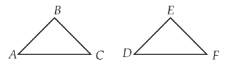
If in two similar triangles $A B C$ and $D E F$, $\frac{A B}{D E}=\frac{B C}{E F}$, then
  • $\angle B=\angle E$
  • B
    $\angle A=\angle E$
  • C
    $\angle B=\angle D$
  • D
    $\angle A=\angle F$

Answer

Correct option: A.
$\angle B=\angle E$
(a) : We have, $\triangle A B C \sim \triangle D E F$
Image
Also, $\frac{A B}{D E}=\frac{B C}{E F}$ (Given)
By SAS similarity criterion, $\angle B=\angle E$.

Need a full question paper?

Generate a complete, print-ready paper with questions like this in minutes — across 16+ boards, with answer keys.

Start Generating Free

Similar questions

In a circle of radius $14 \ cm$ , an arc subtends an angle of $120^{\circ}$ at the centre. If $\sqrt{3}=1.73$ then the area of the segment of the circle is
Choose the correct answer from the given four options : A school has five houses $A, B, C, D$ and $E$. A class has $23$ students, $4$ from house $A, 8$ from house $B, 5$ from house $C, 2$ from house $D$ and rest from house $E.$ A single student is selected at random to be the class monitor. The probability that the selected student is not from $A, B$ and $C$ is :
If 35 is removed from the data: 30, 34, 35, 36, 37, 38, 39, 40, then the median increases by
In a cyclic quadrilateral $\text{ABCD},$ if $\angle\text{A} = (2\text{x}-1)^\circ,\angle\text{B}=(\text{y}+5)^\circ,\angle\text{C} = (2\text{y}+15)^\circ$ and $\angle\text{D}= (4\text{x}-7)^\circ$ then the value of $\angle\text{C}$ is :
A bag contains $100$ cards numbered $1$ to $100.$ A card is drawn at random from the bag. What is the probability that the number on the card is a perfect cube?
$\left(\frac{1-\tan ^2 30^{\circ}}{1+\tan ^2 30^{\circ}}\right)$ is equal to:
The pair of tangents AP and AQ drawn from an external point to a circle with centre O are perpendicular to each other and length of each tangent is 5cm. The radius of
the circle is:
A buffalo is tied to a peg at one corner of an equilateral triangle shaped the gross field of side $35m$ by means of a $21m$ long rope. The area of that part of the field in which the buffalo can graze is :
Choose the correct answer from the given four options : The $4^{th}$ term from the end of the $AP$ : $–11, –8, –5, ..., 49$ is :
If A(-6, 7) and B(-1, -5) are two given points then the distance 2AB is: