MCQ
If $\left| {\,\begin{array}{*{20}{c}}{x + 1}&3&5\\2&{x + 2}&5\\2&3&{x + 4}\end{array}\,} \right| = 0$, then $ x =$
  • A
    $1, 9$
  • B
    $-1, 9$
  • C
    $-1, -9$
  • $1, -9$

Answer

Correct option: D.
$1, -9$
d
(d) By ${C_1} \to {C_1} + {C_2} + {C_3}$,

we have $(9 + x)$ $\left| {\,\begin{array}{*{20}{c}}1&3&5\\1&{x + 2}&5\\1&3&{x + 4}\end{array}\,} \right|$ = 0

$ \Rightarrow $ $(x + 9)$ $\left| {\,\begin{array}{*{20}{c}}0&{1 - x}&0\\0&{ - (1 - x)}&{1 - x}\\1&3&{x + 4}\end{array}\,} \right| = 0$

$ \Rightarrow $ $(x + 9)$ ${(1 - x)^2}\left| {\,\begin{array}{*{20}{c}}0&1&0\\0&{ - 1}&1\\1&3&{x + 4}\end{array}\,} \right| = 0$

$ \Rightarrow $ $x = 1,\,1,\, - 9$, 

Need a full question paper?

Generate a complete, print-ready paper with questions like this in minutes — across 16+ boards, with answer keys.
Start Generating Free

Similar questions

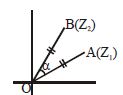
Let $z_1$, $z_2$ are the two complex number and roots of the equation $z^2 + az + b = 0$ and $O$ is the origin, such that $OA = OB$ and ${a^2} = \lambda b{\ \cos ^2}\ \frac{\alpha }{2}$, then $\lambda$ is equal to
$\int_{\,0}^{\,1} {\,{{\tan }^{ - 1}}\left( {\frac{1}{{{x^2} - x + 1}}} \right)\,dx} $ is
Let $ABC = I$ then $tr(ABC + BCA + CAB)$ is (where order of matrices $A, B, C$ is $3$ and $tr(A)$ is sum of diagonal elements in $A$)
The sum of the infinite series $\frac{1}{9} + \frac{1}{{18}} + \frac{1}{{30}} + \frac{1}{{45}} + \frac{1}{{63}} + ..........\infty$ is equal to :-
If the chord $y = mx + 1$ of the circle ${x^2} + {y^2} = 1$ subtends an angle of measure ${45^o}$ at the major segment of the circle then value of $m$ is
Matrix $A$ satisfies $A^2 = 2A - I$ where $I$ is the identity matrix then for $n \ge 2$, $A^n$ is equal to $(n \in N)$
$z=30 x-30 y+1800$ is a objective function. The corner points of the feasible region are $(15,0),(15,15),(10,20),(0,20)$ and $(0,15) $. $z$ has the minimum value at $\ldots \ldots \ldots .$ point.
Let $A=\left\{\theta \in R:\left(\frac{1}{3} \sin \theta+\frac{2}{3} \cos \theta\right)^2=\frac{1}{3} \sin ^2 \theta+\frac{2}{3} \cos ^2 \theta\right\}$.Then
If the sum of the roots of the quadratic equation $a{x^2} + bx + c = 0$is equal to the sum of the squares of their reciprocals, then $\frac{{{b^2}}}{{ac}} + \frac{{bc}}{{{a^2}}} = $
If the system of equations
$x +(\sqrt{2} \sin \alpha) y + (\sqrt{2} \cos \alpha)z=0$
$x + (\cos a)y + (\sin a)z = 0$
$x + (\sin x)y - (\cos a)z = 0$
has a non-trivial solution, then $\alpha \in\left(0, \frac{\pi}{2}\right)$