MCQ
If $\left| {{{\vec v}_1} + {{\vec v}_2}} \right| = \left| {{{\vec v}_1} - {{\vec v}_2}} \right|$ and ${{{\vec v}_1}}$ and ${{{\vec v}_2}}$ are finite, then
  • A
    ${{{\vec v}_1}}$ is parallel to ${{{\vec v}_2}}$
  • B
    ${{{\vec v}_1} = {{\vec v}_2}}$
  • C
    $\left| {{{\vec v}_1}} \right| = \left| {{{\vec v}_2}} \right|$
  • ${{{\vec v}_1}}$ and ${{{\vec v}_2}}$ are mutually perpendicular
Answer

Correct option: D.
${{{\vec v}_1}}$ and ${{{\vec v}_2}}$ are mutually perpendicular
d

Need a full question paper?

Generate a complete, print-ready paper with questions like this in minutes — across 16+ boards, with answer keys.

Start Generating Free

Similar questions

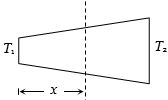
Radius of a conductor increases uniformly from left end to right end as shown in fig.Material of the conductor is isotropic and its curved surface is thermally isolated from surrounding. Its ends are maintained at temperatures $T_1$ and $T_2$ ($T_1$ > $T_2$): If, in steady state, heat flow rate is equal to $H$ , then which of the following graphs is correct
The value of a unit vector in the direction of vector $A = 5\hat i - 12\hat j,$ is
A $150 \,m$ long train is moving with a uniform velocity of $45 \,km/h$. The time taken by the train to cross a bridge of length $850 $ meters is..........$sec$
Two particles are in $SHM$ on same straight line with amplitude $A$ and $2A$ and with same angular frequency $\omega .$ It is observed that when first particle is at a distance $A/\sqrt{2}$ from origin and going toward mean position, other particle is at extreme position on other side of mean position. Find phase difference between the two particles
The damping force on an oscillator is directly proportional to the velocity.The units of the constant of proportionality are
$Assertion :$ The root mean square and most probable speeds of the molecules in a gas are the same.
$Reason :$ The Maxwell distribution for the speed of molecules in a gas in symmetrical.
A wheel of radius 20cm is pushed to move it on a rough horizontal surface. It is found to move through a distance of 60cm on they road during the time it completes one revolution about the centre. Assume that the linear and the angular accelerations are uniform. The frictional force acting on the wheel by the surface is:
A neutron exerts a force on a proton which is:
A wire fixed at the upper end stretches by length I by applying a force F. The work done in stretching is:
A steel rod of length 1m and radius 10mm is stretched by a force 100kN along its length. The stress produced in the rod is Ysteel = 2 × 10¹¹Nm-2.