MCQ
If liquids $A$ and $B$ form an ideal solution
  • A
    The free energy of mixing is zero
  • B
    The free energy as well as entropy of mixing are zero
  • Enthalpy of mixing is zero
  • D
    The entropy of mixing is zero

Answer

Correct option: C.
Enthalpy of mixing is zero
c
For an ideal solution, we know that:-

$a) \,V_{\text {mix }}=0$

$b) \,H _{\text {mix }}=0$

$c) \,\Delta G _{\operatorname{mix}}=- ve$

Need a full question paper?

Generate a complete, print-ready paper with questions like this in minutes — across 16+ boards, with answer keys.

Start Generating Free

Similar questions

At  $25\,^o C$, the dissociation constant of a base $BOH$ is $1.0 \times {10^{ - 12}}$. The concentration of Hydroxyl ions in $0.01\, M$ aqueous solution of the base would be
Choose the correct statement($s$) among the following.

$(A)$ $SnCl _2 \cdot 2 H _2 O$ is a reducing agent.

$(B)$ $SnO _2$ reacts with $KOH$ to form $K _2\left[ Sn ( OH )_6\right]$.

$(C)$ A solution of $PbCl _2$ in $HCl$ contains $Pb ^{2+}$ and $Cl ^{-}$ions.

$(D)$ The reaction of $Pb _3 O _4$ with hot dilute nitric acid to give $PbO _2$ is a redoxreaction.

When $P$ reacts with caustic soda, the products are $P{H_3}$ and $Na{H_2}P{O_2}.$ This reaction is an example of
A molar solution is one that contains one mole of a solute in
Octahedral molecular shape exists in .......... hybridisation
Which of the following is least reactive towards electrophilic substitution
Calculate $\Delta H \,(kJ/mole)$ for the reaction :-
$2FeO_{(s)} + \frac{1}{2}\, O_{2(g)} \to Fe_2O_{3(g)}$

Given                                                                                                   $\Delta H$

$(i)\, Fe_2O_{3(s)}+3C_{(graphite)} \to 2Fe_{(s)} + 3CO_{(g)}$         $492\, kJ/mol$

$(ii)\, FeO_{(s)}+C_{(graphite)} \to Fe_{(s)} + CO_{(g)}$                     $156\, kJ/mol$

$(iii)\, C_{(graphite)} + O_{2(g)} \to CO_{2(g)}$                                   $-393 \,kJ/mol$

$(iv)\, CO_{(g)} + \frac{1}{2}\, O_{2(g)} \to CO_{2(g)}$                            $-283\, kJ/mol$
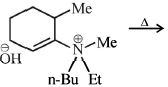
The alkene formed as a major product in the below elimination reaction is
Assertion : Sigma $(\sigma )$ is a strong bond, while pi $(\pi )$ is a weak bond.
Reason : Atoms rotate freely about pi $(\pi )$ bond.
Which of the following represents $180\, g$ of water correctly ?