MCQ
If matrix $A = \left[ {\begin{array}{*{20}{c}}1&0&{ - 1}\\3&4&5\\0&6&7\end{array}} \right]$ and its inverse is denoted by ${A^{ - 1}} = \left[ {\begin{array}{*{20}{c}}{{a_{11}}}&{{a_{12}}}&{{a_{13}}}\\{{a_{21}}}&{{a_{22}}}&{{a_{23}}}\\{{a_{31}}}&{{a_{32}}}&{{a_{33}}}\end{array}} \right]$, then the value of ${a_{23}}$=
  • A
    $\frac{{21}}{{20}}$
  • B
    $\frac{1}{5}$
  • $\frac{2}{5}$
  • D
    $ - \frac{2}{5}$

Answer

Correct option: C.
$\frac{2}{5}$
c
(c) $|A|\, = \, - 20$

$\therefore \,\,{a_{23}} = \frac{{{\rm{Cofactor of 6}}}}{{ - 20}} = \frac{{ - 8}}{{-20}} = \frac{{  2}}{5}$.

Need a full question paper?

Generate a complete, print-ready paper with questions like this in minutes — across 16+ boards, with answer keys.

Start Generating Free

Similar questions

if x lies in the interval $[0, 1]$, then the least value of $x^2 + x + 1$ is :
The area (in sq. units) of the region $\left\{ {x \in R:x \ge } \right.0,\,y \ge 0,\,y \ge x - 2\,and\,y \le \sqrt x \} \,,\,$ is
If $\cos^{-1}\text{x}>\sin^{-1}\text{x},$ then:
The shortest distance between the lines $\frac{x-3}{3}=\frac{y-8}{-1}=\frac{z-3}{1}$ and $\frac{x+3}{-3}=\frac{y+7}{2}=\frac{z-6}{4}$ is
Three numbers are chosen at random, one after another with replacement, from the set $S=\{1,2,3, \ldots, 100\}$. Let $p_1$ be the probability that the maximum of chosen numbers is at least 81 and $p _2$ be the probability that the minimum of chosen numbers is at most $40$ .

($1$) The value of $\frac{625}{4} p _1$ is

($2$) The value of $\frac{125}{4} p _2$ is

Give the answer or queution ($1$) and ($2$)

Let $y=y(x)$ satisfies the equation $\frac{d y}{d x}-|A|=0$, for all $x>0$, where $A=\left[\begin{array}{ccc}y & \sin x & 1 \\ 0 & -1 & 1 \\ 2 & 0 & \frac{1}{x}\end{array}\right] .$

If $y(\pi)=\pi+2$, then the value of $y\left(\frac{\pi}{2}\right)$ is:

$\int {\frac{{{{\sin }^3}2x}}{{{{\cos }^5}2x}}dx = } $
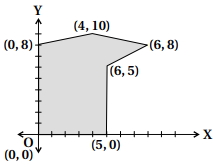
The feasible solution for a $LPP$ is shown in Figure Let $z=3 x-4 y$ be the objective function. Maximum of $Z$ occurs at $......$
For the function$x + {1 \over x},x \in [1,\,3]$, the value of $ c$  for the mean value theorem is
Choose the correct answer from the given four options.
The angle between two vectors $\vec{\text{a}}$ and $\vec{\text{b}}$ with magnitudes $\sqrt{3}$ and 4, respectively, and $\vec{\text{a}}\cdot\vec{\text{b}}=2\sqrt{3}$ is: