Question
If $\mid\text{a}\times\text{b}\mid=4$ and $\mid\text{a.b}\mid=2$ then $\mid{\text{a}}\mid^2\mid{\text{b}}\mid^2$ is equal to:
  1. 4
  2. 6
  3. 20
  4. 2

Answer

  1. 20

Need a full question paper?

Generate a complete, print-ready paper with questions like this in minutes — across 16+ boards, with answer keys.
Start Generating Free

Similar questions

What is the solution of $\text{x}\leq4,\text{y}\geq0$ and $\text{x}\leq-4,\text{y}\geq0$?
  1. $\text{x}\geq-4,\text{y}\leq0$
  2. $\text{x}\leq4,\text{y}\geq0$
  3. $\text{x}\leq-4,\text{y}=0$
  4. $\text{x}\geq-4,\text{y}=0$
The value of $ \left( {{{\tan }^{ - 1}}\pi + {{\tan }^{ - 1}}\left( {\frac{1}{\pi }} \right)} \right) + {\tan ^{ - 1}}\sqrt 3 - {\sec ^{ - 1}}( - 2)$ is equal to
  1. $ \frac{{ - \pi }}{3}$
  2. $ \frac{{ \pi }}{6}$
  3. $ \frac{{ 2 \pi }}{3}$
  4. $ \pi$
The value of $\cos^{-1}\Big(\cos\frac{5\pi}{3}\Big)+\sin^{-1}\Big(\sin\frac{5\pi}{3}\Big)$ is:
  1. $\frac{\pi}{2}$
  2. $\frac{5\pi}{3}$
  3. $\frac{10\pi}{3}$
  4. $0$
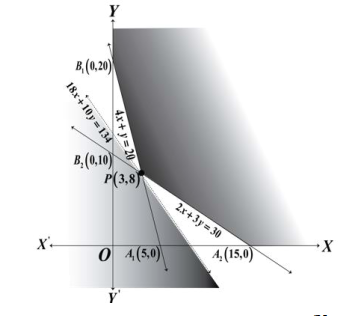
A linear programming problem (LPP) along eith the graph of its constraints is shown below.The correspondig objective function is :Z = 18x + 10y which has to be minimized. The smallest value of the objective function Z is 134 and is obtained at the corner point (3,8).
Image
The optimal solution of the above linear programming problem_______________.
Choose the correct answer from the given four option.
The degree of the differential equation $\Big(\frac{\text{d}^2\text{y}}{\text{d}\text{x}^2}\Big)+\Big(\frac{\text{d}\text{y}}{\text{d}\text{x}}\Big)^2-\sin\Big(\frac{\text{d}\text{y}}{\text{d}\text{x}}\Big)$ is:
  1. 1
  2. 2
  3. 3
  4. Not defined
The solution of the equation $\frac{d y}{d x}=e^{x-y}$ is :
For any matrix $A , A =\left[\begin{array}{cc}\alpha & -2 \\ -2 & \alpha\end{array}\right],\left| A ^3\right|=125$ then value of $\alpha$ is :
If the x-coordinate of a point P on the join of Q(2, 2, 1) and R(5, 1, -2) is 4, then its z-coordinate is:
Objective of LPP is:
The equation of the line passing through the points $\text{a}_1\hat{\text{i}}+\text{a}_2\hat{\text{j}}+\text{a}_3\hat{\text{k}}$ and $\text{b}\hat{\text{i}}+\text{b}_2\hat{\text{j}}+\text{b}_3\hat{\text{k}}$ is:
  1. $\vec{\text{r}}=\big(\text{a}_1\hat{\text{i}}+\text{a}_2\hat{\text{j}}+\text{a}_3\hat{\text{k}}\big)+\lambda\big(\text{b}_1\hat{\text{i}}+\text{b}_2\hat{\text{j}}+\text{b}_3\hat{\text{k}}\big)$
  2. $\vec{\text{r}}=\big(\text{a}_1\hat{\text{i}}+\text{a}_2\hat{\text{j}}+\text{a}_3\hat{\text{k}}\big)-\text{t}\big(\text{b}_1\hat{\text{i}}+\text{b}_2\hat{\text{j}}+\text{b}_3\hat{\text{k}}\big)$
  3. $\vec{\text{r}}=\text{a}_1(1-\text{t})\hat{\text{i}}+\text{a}_2(1-\text{t})\hat{\text{j}}+\text{a}_3(1-\text{t})\hat{\text{k}}+\text{t}\big(\text{b}_1\hat{\text{i}}+\text{b}_2\hat{\text{j}}+\text{b}_3\hat{\text{k}}\big)$
  4. $\text{None of these}$