MCQ
If $n + l = 6$, then total possible number of subshells would be
  • $3$
  • B
    $4$
  • C
    $2$
  • D
    $5$

Answer

Correct option: A.
$3$
a
(a) Possible number of subshells would be ($6s, 5p, 4d$).

Need a full question paper?

Generate a complete, print-ready paper with questions like this in minutes — across 16+ boards, with answer keys.

Start Generating Free

Similar questions

Match List$-I$ with List$-II$:

List$-I$

(Parameter)

List$-II$

(Unit)

$(a)$ Cell constant $(i)$ $\mathrm{S}\, \mathrm{cm}^{2} \,\mathrm{~mol}^{-1}$
$(b)$ Molar conductivity $(ii)$ Dimensionless
$(c)$ Conductivity $(iii)$ $\mathrm{m}^{-1}$
$(d)$ Degree of dissociation of electrolyte $(iv)$ $\Omega^{-1} \,\mathrm{~m}^{-1}$

Choose the most appropriate answer from the options given below :
Enthalpy of sublimation of iodine is $24\, cal\, g^{-1}$ at $200\,^oC$. If specific heat of $I_2(s)$ and $I_2(vap)$ are $0.055$ and $0.031\, cal\, g^{-1}K^{-1}$ respectively, then enthalpy of sublimation of iodine at $250\,^oC$ in $cal\, g^{-1}$ is
The $pH$ of a buffer solution containg $0.2$ mole per litre $C{H_3}COONa$ and $1.5$ mole per litre $C{H_3}COOH$ is ($Ka$ for acetic acid is $1.8 \times {10^{ - 5}})$
Which of the following will not given Hoffmann bromamide rection ?
The osmotic pressure of $2.22\  \%\ (w/v) CaCl_2$ solution at $27\,^oC$ is $(R = 0.08\  L-atm/K-mol)$
Which one of the following sets of quantum numbers represents an impossible arrangement?
Electronic configuration of four elements $\mathrm{A}, \mathrm{B}, \mathrm{C}$ and D are given below :
(A) $1 \mathrm{~s}^{2} 2 \mathrm{~s}^{2} 2 \mathrm{p}^{3}$
(B) $1 s^{2} 2 s^{2} 2 p^{4}$
(C) $1 \mathrm{~s}^{2} 2 \mathrm{~s}^{2} 2 \mathrm{p}^{5}$
(D) $1 \mathrm{~s}^{2} 2 \mathrm{~s}^{2} 2 \mathrm{p}^{2}$
Which of the following is the correct order of increasing electronegativity (Pauling's scale)?
Which of the following has maximum ionization potential
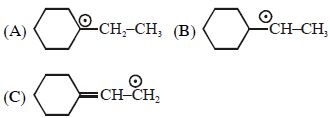
Arrange the following radical order of decreasing stability
The decomposition of ${N_2}{O_5}$ occurs as, $2{N_2}{O_5} \to 4N{O_2} + {O_2}$, and follows first order kinetics, hence