MCQ
If $n=2$ for $H e^{+}$ ion than ...........$\mathop A\limits^o $ out the wave length
- ✓$3.33$
- B$6.42$
- C$1.47$
- D$2.37$
$2 \pi r = n \lambda \quad \because r=0.529 \frac{ n ^{2}}{ Z }$
$2 \pi \times 0.529 \frac{ n ^{2}}{ Z } A = n \lambda$
$\lambda=\frac{2 \times 3.14 \times 0.529 \times 2}{2} A$
$\lambda=3.33\,\mathop A\limits^o $
Generate a complete, print-ready paper with questions like this in minutes — across 16+ boards, with answer keys.
$X + \frac{1}{2}{O_2}\,\, \to \,\,XO + 90.8\,kJ$
It follows that the heat of reaction for the following process $M + XO$ $\rightleftharpoons$ $MO + X$ is given by......$kJ$
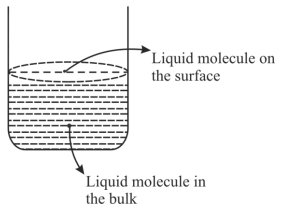
$A.$ Surface tension is the outcome of equal attractive and repulsion forces acting on the liquid molecule in bulk.
$B.$ Surface tension is due to uneven forces acting on the molecules present on the surface.
$C.$ The molecule in the bulk can never come to the liquid surface.
$D.$ The molecules on the surface are responsible for vapour pressure if the system is a closed system.