Question
If non-parallel sides of a trapezium are equal, prove that it is cyclic.
Answer

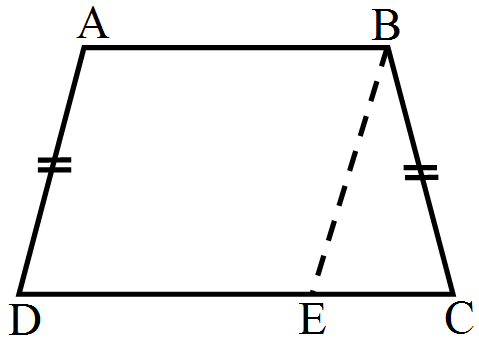
Given: ABCD is a trapezium whose non-parallel sides AD and BC are equal.

To prove: Trapezium ABCD is a cyclic
Join BE, where BE || AD.
Proof: Since, AB || DE and AD || BE
Since, the quadrilateral ABCD is a parallelogram,
$\therefore\angle\text{BAD}=\angle\text{BED}\ \ ...(\text{i})$ [opposite angles of a parallelogram are equal]
and AD = BE ...(ii) [opposite sides of a parallelogram are equal]
But, AD = BC [given] ...(iii)
From Eqs. (ii) and (iii), BC = BE
$\Rightarrow\angle\text{BEC}=\angle\text{BCE}\ \ ...\text{(iv)}$ [angle opposite to equal sides are equal]
Also, $\angle\text{BEC}+\angle\text{BED}=180^\circ$ [linear pair axiom]
$\therefore\angle\text{BCE}+\angle\text{BAD}=180^\circ$ [from Eqs. (i) and (iv)]
If sum of opposite angles of a quadrilateral is 180°, then quadrilateral is cyclic.
Hence, trapezium ABCD is a cyclic.
Hence proved.

Need a full question paper?

Generate a complete, print-ready paper with questions like this in minutes — across 16+ boards, with answer keys.
Start Generating Free

Similar questions

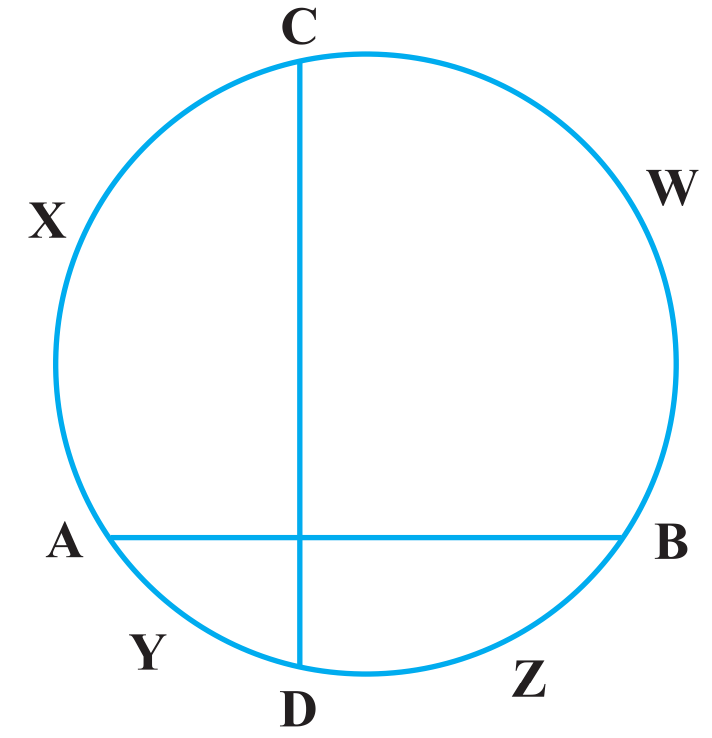
If two chords AB and CD of a circle AYDZBWCX intersect at right angles (see Fig.), prove that arc CXA + arc DZB = arc AYD + arc BWC = semi-circle.

The dimension of a room are (9m × 8m × 6.5m). It has one door of dimension (2m × 1.5m) and two window, each of dimension (1.5 × 1m). Find the cost of whitewashing the walls at ₹ 25 per square metre.
Given below is a table which shows the yearwise strength of a school. Represent this data by a bar graph.
Year
2012-13
2013-14
2014-15
2015-16
2016-17
Number of students
800
975
1100
1400
1625
Construct a $\triangle\text{ABC}$ in which BC = 3.6cm, AB + AC = 4.8cm and $\angle\text{B}=60^\circ. $
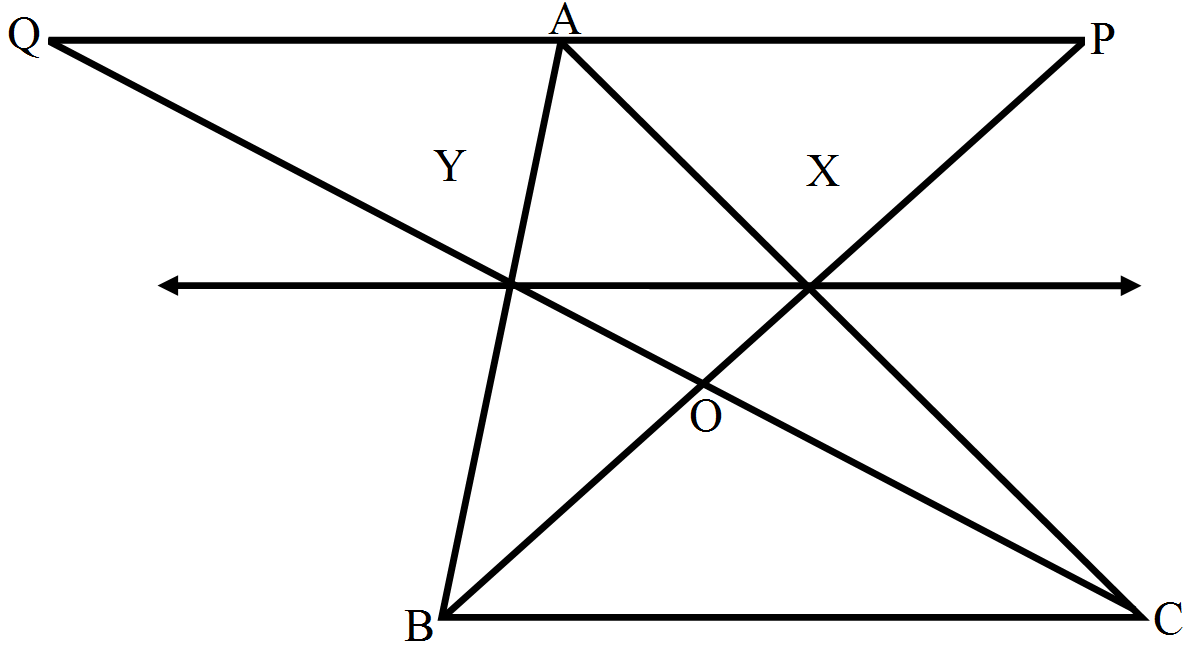
In figure, X and Y are the mid points of AC and AB respectively, QP || BC and CYQ and BXP are straight lines. Prove that $\text{ar}(\triangle\text{ABP})=\text{ar}(\triangle\text{ACQ}).$

If the mean of the following data is 15, find p.
f:
p
6
10
5
x:
5
10
15
20
25
Simplify the following products:
$\Big(\frac{1}{2}\text{a}-3\text{b}\Big)\Big(3\text{b}+\frac{1}{2}\text{a}\Big)\Big(\frac{1}{4}\text{a}^2+9\text{b}^2\Big)$
A bag contains 4 white balls and some red balls. If the probability of drawing a white ball from the bag is $\frac{2}{5},$ find the number of red balls in the bag.
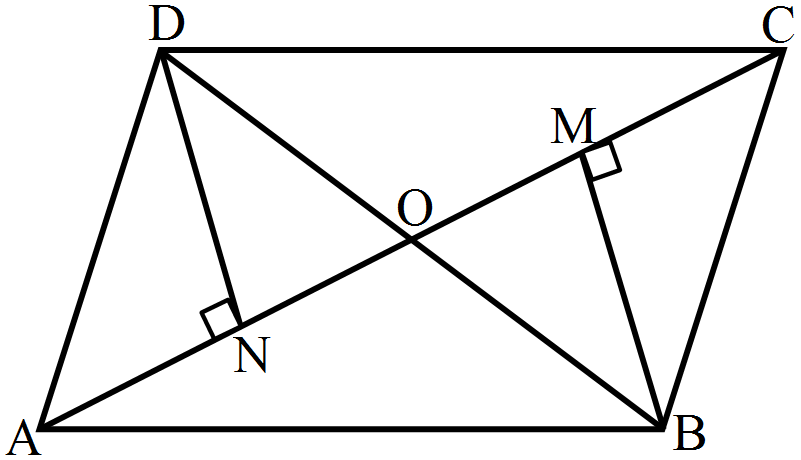
In the adjoining figure, $\text{BM}\perp\text{AC}$ and $\text{DN}\perp\text{AC}.$ If BM = DN, prove that AC bisects BD.
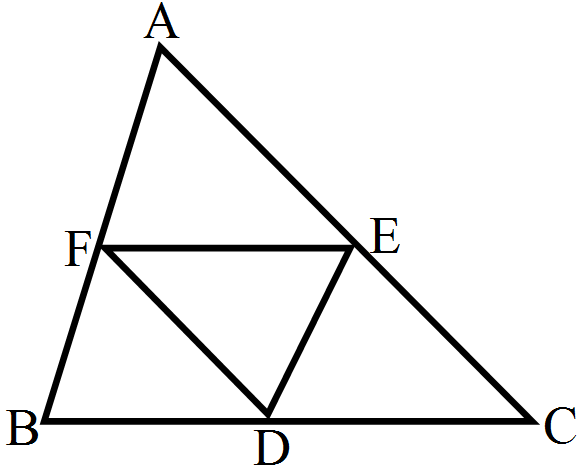
In the adjoining figure, D, E, F are the midpoints of the sides BC, CA and AB respectively, of $\triangle\text{ABC}.$ Show that $\angle\text{EDE}=\angle\text{A},\angle\text{DEF}=\angle\text{B}$ and $\angle\text{DFE}=\angle\text{C}.$