Question
If non-parallel sides of a trapezium are equal, prove that it is cyclic.

Answer

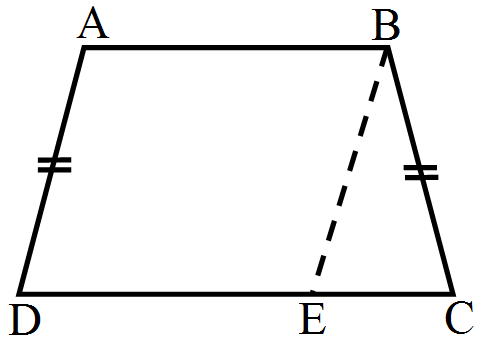
Given: $ABCD$ is a trapezium whose non-parallel sides $AD$ and $BC$ are equal.

To prove: Trapezium $ABCD$ is a cyclic Join $BE,$ where $BE || AD.$
Proof: Since, $AB || DE$ and $AD || BE$ Since, the quadrilateral $ABCD$ is a parallelogram, $\therefore\angle\text{BAD}=\angle\text{BED}\ \ ...(\text{i})$ [opposite angles of a parallelogram are equal] and $AD = BE ...(ii)$ [opposite sides of a parallelogram are equal] But,
​​​​​​​$AD = BC [$given$] ...(iii)$ From Eqs. $(ii)$ and $(iii),$
$BC = BE$
$\Rightarrow\angle\text{BEC}=\angle\text{BCE}\ \ ...\text{(iv)}$ [angle opposite to equal sides are equal]
Also, $\angle\text{BEC}+\angle\text{BED}=180^\circ[$ linear pair axiom$]$
$\therefore\angle\text{BCE}+\angle\text{BAD}=180^\circ [$from Eqs. $(i)$ and $(iv)]$
If sum of opposite angles of a quadrilateral is $180^\circ $, then quadrilateral is cyclic.
​​​​​​​Hence, trapezium $ABCD$ is a cyclic. Hence proved.

Need a full question paper?

Generate a complete, print-ready paper with questions like this in minutes — across 16+ boards, with answer keys.
Start Generating Free

Similar questions

If $2 x+3 y=13$ and $x y=6$, find the value of $8 x^3+27 y^3$.
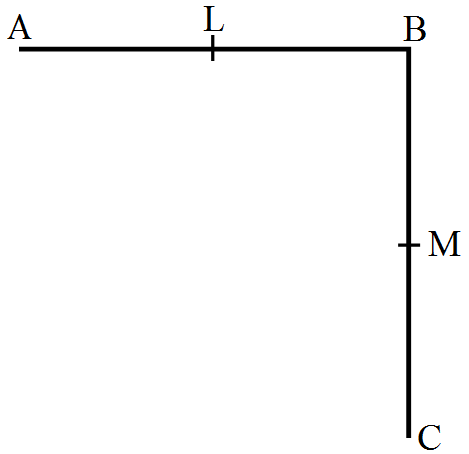
In the given figure, $L$ and $M$ are the mid$-$points of $AB$ and $BC$ respectively.
 
$i.$ If $AB = BC$, prove that $AL = MC$.
$ii.$ If $BL = BM$, prove that $AB = BC$.
Hint:
$i.\text{AB}=\text{BC}$
$\Rightarrow\frac{1}{2}\text{AB}=\frac{1}{2}\text{BC}$
$\Rightarrow\text{AL}=\text{MC}.$
$ii.\text{BL}=\text{BM}$
$\Rightarrow2\text{BL}=2\text{BM}$
$\Rightarrow\text{AB}=\text{BC}.$
Is it possible to draw a triangle with sides of length $2\ cm, 3\ cm$ and $7\ cm?$
Draw a circle with centere at point $O$. Draw its two chords $AB$ and $CD$ such that $AB$ is not parallel to $CD$. Draw the perpendicular bisectors of $AB$ and $CD$. At what point do they intersect?
A cube of side $4\ cm$ contains a sphere touching its sides. Find the volume of the gap in between.
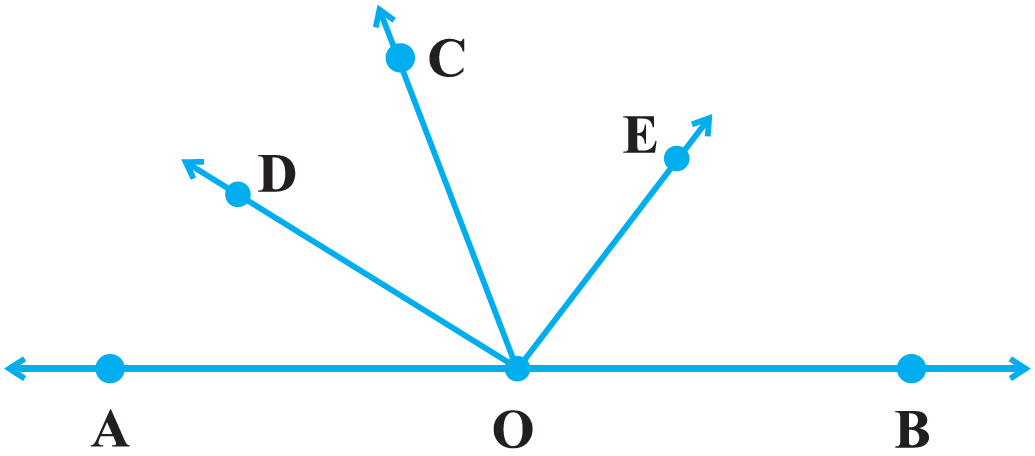
In Fig. $OD$ is the bisector of $\angle\text{AOC}, OE$ is the bisector of $\angle\text{BOC}$ and $\text{OD}\perp\text{OE}.$ Show that the points $A, O$ and $B$ are collinear.
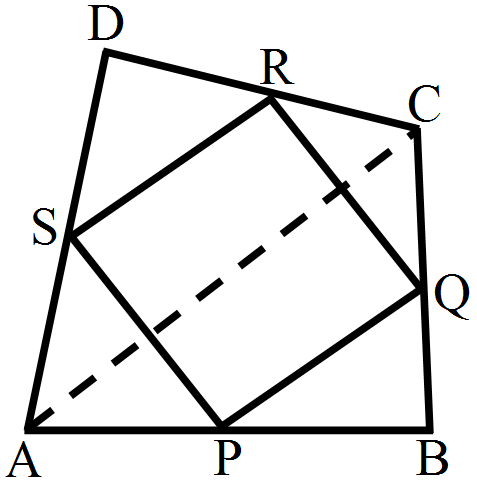
$P , Q, R$ and $S$ are respectively the midpoints of the sides $AB, BC, CD$ and $DA$ of a quadrilateral $\text{ABCD}$. Show that:
$i. PQ \| AC$ and $\text{PQ}=\frac{1}{2}\text{AC}$
$ii. PQ \| SR$
$iii. \text{PQRS}$ is a parallelogram.
If $\text{x}=\frac{5-\sqrt{21}}{2},$ find the value of $\text{x}+\frac{1}{\text{x}}.$
Two equal chords AB and CD of a circle when produced intersect at a point P. Prove that PB = PD
The difference between inside and outside surfaces of a cylindrical tube is $14\ cm$ long is $88\ sq$. cm. If the volume of the tube is $176$ cubic $cm$, Find the inner and outer radii of the tube.