MCQ
If $\omega $ is a cube root of unity and $\Delta = \left| {\begin{array}{*{20}{c}}1&{2\omega }\\\omega &{{\omega ^2}}\end{array}} \right|$, then ${\Delta ^2}$ is equal to
  • A
    $ - \omega $
  • $\omega $
  • C
    $1$
  • D
    ${\omega ^2}$

Answer

Correct option: B.
$\omega $
b
(b) Since $\Delta = {\omega ^2} - 2{\omega ^2} = - {\omega ^2}$.

Therefore ${\Delta ^2} = {\omega ^4} = \omega $.

Need a full question paper?

Generate a complete, print-ready paper with questions like this in minutes — across 16+ boards, with answer keys.

Start Generating Free

Similar questions

The area of the region $\left\{(x, y):|x-1| \leq y \leq \sqrt{5-x^{2}}\right\}$ is equal to.
The value of $\int_0^1 {{x^2}{e^x}dx} $ is equal to
Choose the correct answer from the given four options:
The area of the region bounded by the curve x2 = 4y and the straight line x = 4y - 2 is:
  1. $\frac{3}{8}\text{ sq. units}$
  2. $\frac{5}{8}\text{ sq. units}$
  3. $\frac{7}{8}\text{ sq. units}$
  4. $\frac{9}{8}\text{ sq. units}$
$\int\frac{\text{e}^{\text{x}}(1+\text{x})}{\cos^2(\text{x}\text{e}^{\text{x}})}\text{ dx}=$
  1. $2\log_\text{e}\cos(\text{xe}^{\text{x}})+\text{C}$
  2. $\sec(\text{xe}^{\text{x}})+\text{C}$
  3. $\tan(\text{xe}^{\text{x}})+\text{C}$
  4. $\tan(\text{x}+\text{e}^{\text{x}})+\text{C}$
If for the matrix A, A3 = I, than A-1 =
  1. A2
  2. A3
  3. A
  4. None of these.
If the direction cosines of a line are $\left(\frac{1}{a}, \frac{1}{a}, \frac{1}{a}\right)$, then
The differential equation obtained on eliminating A and B from $\text{y}=\text{A}\cos\omega\text{t}+\text{B}\sin\omega\text{t}$ is:
  1.   $\text{y}''+\text{y}'=0$
  2. $\text{y}''-\omega^{2}\text{y}=0$
  3. $\text{y}''=-\omega^{2}\text{y}=0$
  4. $\text{y}''+\text{y}=0$ 
Find the determinant of the matrix $\text{A}=\begin{bmatrix}-\cos\theta&-tan\theta\\\cot\theta&\cos\theta\end{bmatrix}$ is:
  1. $\sin^2\theta$
  2. $\sin\theta$
  3. $-\sin\theta$
  4. $-\sin^2\theta$
$r \times a = b \times a;\,\,r \times b = a \times b;\,\,a \ne 0;\,\,b \ne 0;\,\,a \ne \lambda b,\,\,$ $a $ is not perpendicular to $ b,$  then $r = $
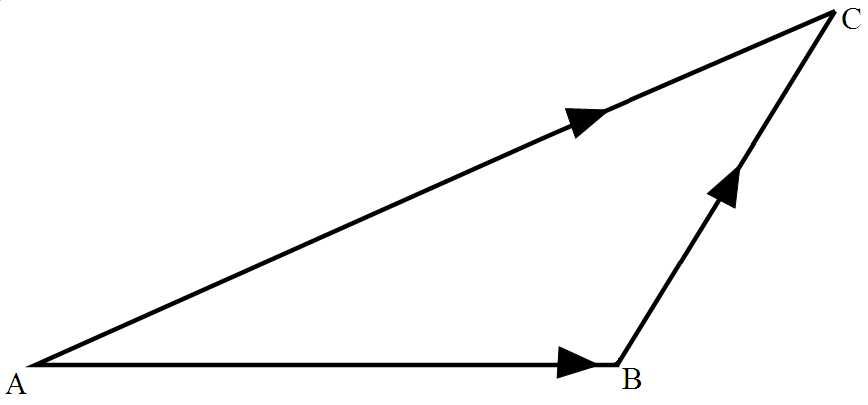
In figure, which of the following is not true?

  1. $​​​​​\overrightarrow{\text{AB}}+\overrightarrow{\text{BC}}+\overrightarrow{\text{CA}}=\vec0$

  2. $​​​​​\overrightarrow{\text{AB}}+\overrightarrow{\text{BC}}-\overrightarrow{\text{AC}}=\vec0$

  3. $​​​​​\overrightarrow{\text{AB}}+\overrightarrow{\text{BC}}-\overrightarrow{\text{CA}}=\vec0$

  4. $​​​​​\overrightarrow{\text{AB}}-\overrightarrow{\text{CB}}+\overrightarrow{\text{CA}}=\vec0$