Question
If $p(x) = 4x^3 - 3x^2 + 2x - 4$ find the remainderwhen $p(x)$ is divided by:
$x+\frac{1}{2}$.

Answer

$p(x)=4 x^3-3 x^2+2 x-4$ .... (i)
By the remainder theorem the required remainder
$= p \left(-\frac{1}{2}\right) \text {. }$
Put $x=\left(-\frac{1}{2}\right)$ in equation (i) we get
$ p\left(-\frac{1}{2}\right)=4\left(-\frac{1}{2}\right)^3-3\left(-\frac{1}{2}\right)^2+2\left(-\frac{1}{2}\right)-4$
$=4 \times\left(\frac{1}{8}\right)-3 \times \frac{1}{4}+2 \times\left(-\frac{1}{2}\right)-4$
$=-\frac{1}{2}-\frac{3}{4}-1-4$
$=\frac{-2-3-4-16}{4}$
$=-\frac{25}{4} $
Hence, the remainder is $-\frac{25}{4}$.

Need a full question paper?

Generate a complete, print-ready paper with questions like this in minutes — across 16+ boards, with answer keys.

Start Generating Free

Similar questions

The present population of a town is $1,15200.$ If it increases at the rate of $6 \frac{2}{3} \%$ per annum , find Its population after $2$ years

Consultancy services, worth Rs. 50,000, are transferred from Delhi to Calcutta at the rate of GST 18% and then from Calcutta to Nainital (with profit = Rs. 20,000) at the same rate of GST. Find the output tax at
  1. Delhi
  2. Calcutta
  3. Nainital
Determine the ratio of the volume of a cube to that of a sphere which will exactly fit inside the cube.
Find the value of k for which the following equation has equal roots:
$(k - 12)x^2+ 2(k - 12)x + 2 = 0.$
Prove that: $2(\sin^6\theta + \cos^6\theta ) - 3 ( \sin^4\theta + \cos^4\theta ) + 1 = 0.$
Find the sub-triplicate ratio of the following :
$m^3n^6 : m^6n^3$
A well of diameter 1 m is dug 7 m deep. The earth taken out of it is completely used for making a conical body of scare-crow. The base diameter of the body is 2 m. Find the height of scare-crow.
Two circle with radii $r_1$ and $r_2$ touch each other externally. Let r be the radius of a circle which touches these two circle as well as a common tangent to the two circles, Prove that: $\frac{1}{\sqrt{r}}+\frac{1}{\sqrt{r}_1}+\frac{1}{\sqrt{r}_2}$.
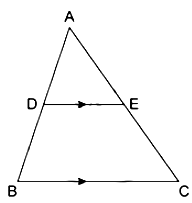
In the following figure, point $D$ divides $AB$ in the ratio $3 : 5.$ Find :$\frac{A E}{A C}$
Without using trigonometrical tables, evaluate:$\operatorname{cosec} 257^{\circ}-\tan ^2 33^{\circ}+\cos 44^{\circ} \operatorname{cosec} 46^{\circ}-\sqrt{2} \cos 45^{\circ}-\tan ^2 60^{\circ}$