MCQ
If relative decrease in vapour pressure is $0.4$ for a solution containing $1\, mol$ $NaCl$ in $3\, mol$ of $H_2O$, the degree of ionization of $NaCl$ is .......... $\%$.
- A$60$
- B$50$
- ✓$100$
- D$40$
$0.4=\frac{i \times 1}{i \times 1+3}$
$0.4 \,\mathrm{i}+1.2= \mathrm{i}$
$0.6 \,\mathrm{i}=1.2$
$i=2$
$\mathop {{\text{NaCl}}({\text{aq}})}\limits_{1 - \,\alpha } \, \rightleftharpoons \mathop {{\text{N}}{{\text{a}}^ + }({\text{aq}})}\limits_\alpha + \mathop {{\text{C}}{{\text{l}}^ - }({\text{aq}})}\limits_\alpha $
$1+\alpha=2$
$\alpha=1$ or $100\%$
Generate a complete, print-ready paper with questions like this in minutes — across 16+ boards, with answer keys.
$X-Y-Z$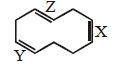
| $I.E.\, (kJ \,mol^{-1})$ | $I.E.\, (kJ\, mol^{-1})$ |
| $A_{(g)} \to A^+_{(g)}+e^-,$ $A_1$ | $B_{(g)} \to B^{+}_{(g)}+e^-,$ $B_1$ |
| $B^+_{(g)} \to B^{2+}_{(g)}+e^-,$ $B_2$ | $C_{(g)} \to C^{+}_{(g)}+e^-,$ $C_1$ |
| $C^+_{(g)} \to C^{2+}_{(g)}+e^-,$ $C_2$ | $C^{2+}_{(g)} \to C^{3+}_{(g)}+e^-,$ $C_3$ |
If monovalent positive ion of $A,$ divalent positive ion of $B$ and trivalent positive ion of $C$ have zero electron. Then incorrect order of corresponding $I.E.$ is
$X_2O_4(g) \to 2XO_2(g)$
$\Delta U = 2.1\, kcal, \Delta S = 20\, cal\, K^{-1}$ at $300\, K$.
Hence $\Delta G$ is ....$kcal$