MCQ
If $\overrightarrow {\rm A} = 2\hat i + 3\hat j - \hat k$ and $\overrightarrow B = - \hat i + 3\hat j + 4\hat k$ a unit vector perpendicular to both $\overrightarrow A $ and $\overrightarrow B $ will be
  • A
    $ + \frac{1}{{\sqrt 3 }}(\hat i - \hat j - \hat k)$
  • B
    $ - \frac{1}{{\sqrt 3 }}(\hat i - \hat j - \hat k)$
  • Both $(a)$ and $(b)$
  • D
    None of these

Answer

Correct option: C.
Both $(a)$ and $(b)$
c
(c) $\hat n = \frac{{\overrightarrow A \, \times \overrightarrow B }}{{|\overrightarrow A \, \times \overrightarrow B |}} = \frac{{8\hat i - 8\hat j - 8\hat k}}{{8\sqrt 3 }} = \frac{1}{{\sqrt 3 }}(\hat i - \hat j - \hat k)$

There are two unit vectors perpendicular to both $\overrightarrow A $ and $\overrightarrow B $ they are $\hat n = \pm \frac{1}{{\sqrt 3 }}(\hat i - \hat j - \hat k)$

Need a full question paper?

Generate a complete, print-ready paper with questions like this in minutes — across 16+ boards, with answer keys.

Start Generating Free

Similar questions

A body is moving on a circle of radius $80 \,m$ with a speed $20 \,m / s$ which is decreasing at the rate $5 \,m / s ^2$ at an instant. The angle made by its acceleration with its velocity is ..........
The radii of two planets are respectively R1 and R2 and their densities are respectively P1 and P2. The ratio of the accelerations due to gravity at their surfaces:
A glass wind screen whose inclination with the vertical can be changed is mounted on a car. The car moves horizontally with a speed of $2\,\,m/s$. At what angle $\alpha$ with the vertical should the wind screen be placed so that the rain drops falling vertically downwards with velocity $6\,\, m/s$ strike the wind screen perpendicularly.
$Assertion$ : A rocket moves forward by pushing the surrounding air backwards.

$Reason$ : It derives the necessary thrust to move forward according to Newton’s third law of motion

If a man pushes a wall and is unable to displace it, he:
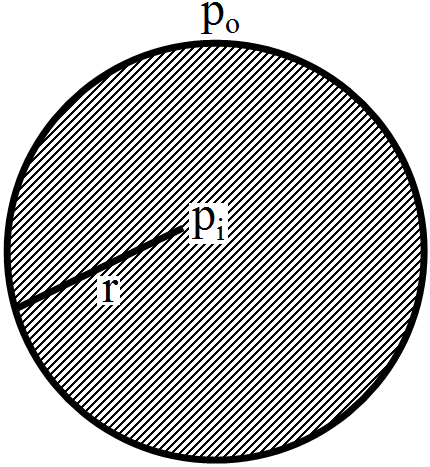
In figure, pressure inside a spherical drop is more than pressure outside. (S = surface tension and r = radius of bubble):

The extra surface energy if radius of bubble is increased by $\Delta\text{r}$ is:
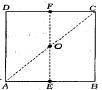
For the given uniform square lamina $ABCD$ , whose centre is $O$,
A block of mass $m$ slides along a floor while a force of magnitude $F$ is applied to it at an angle $\theta$ as shown in figure. The coefficient of kinetic friction is $\mu_{ K }$. Then, the block's acceleration $'a'$ is given by: ($g$ is acceleration due to gravity)
Two particles of mass $5\, kg$ and $10\, kg$ respectively are attached to the two ends of a rigid rod of length $1\, m$ with negligible mass. The centre of mass of the system from the $5\, kg$ particle is nearly at a distance of $..........\, cm$
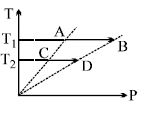
On a $TP$ diagram, two moles of ideal gas perform process $AB$ and $CD$. If the work done by the gas in the process $AB$ is two times the work done in the process $CD$ then what is the value of $T_1/T_2$?