Question
If $\sin^{-1}\frac{2\text{a}}{1+\text{a}^2}+\sin^{-1}\frac{2\text{b}}{1+\text{b}^2}=2\tan^{-1}\text{x},$ prove that $\text{x}=\frac{\text{a}+\text{b}}{1-\text{ab}}.$

Answer

Let: $\text{a}=\tan\text{z}$ $\text{b}=\tan\text{y}$ Then, $\sin^{-1}\frac{2\text{a}}{1+\text{a}^2}+\sin^{-1}\frac{2\text{b}}{1+\text{b}^2}=2\tan^{-1}\text{x}$$\Rightarrow\sin^{-1}\frac{2\tan\text{z}}{1+\tan^2\text{z}}+\sin^{-1}\frac{2\tan\text{y}}{1+\tan^2\text{y}}=2\tan^{-1}\text{x}$
$\Rightarrow\sin^{-1}(\sin2\text{z})+\sin^{-1}(\sin2\text{y})=2\tan^{-1}\text{x}$ $\Big[\because\ \sin2\text{x}=\frac{2\tan\text{x}}{1+\tan^2\text{x}}\Big]$ $\Rightarrow2\text{z}+2\text{y}=2\tan^{-1}\text{x}$ $\Rightarrow\tan^{-1}\text{a}+\tan^{-1}\text{b}=\tan^{-1}\text{x}$ $[\because\ \text{a}=\tan\text{z}\text{ and }\text{b}=\tan\text{y}]$ $\Rightarrow\tan^{-1}\frac{\text{a}+\text{b}}{1-\text{ab}}=\tan^{-1}\text{x}$ $\Big[\because\ \tan^{-1}\text{x}+\tan^{-1}\text{y}=\tan^{-1}\frac{\text{x}+\text{y}}{1-\text{xy}}\Big]$ $\Rightarrow\text{x}=\frac{\text{a}+\text{b}}{1-\text{ab}}$

Need a full question paper?

Generate a complete, print-ready paper with questions like this in minutes — across 16+ boards, with answer keys.
Start Generating Free

Similar questions

Find the principal values of the following:
$\tan^{-1}\Big(-\frac{1}{\sqrt3}\Big)$
Evaluate the integral $\int_{0}^{2} x \sqrt{x+2} ($Put $x + 2 =t^2)$ using substitution.
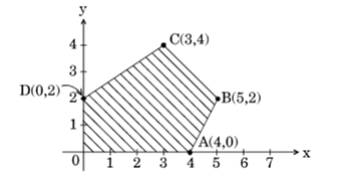
The corner points of the feasible region determined by the system of linear inequations are as shown below :
Image

Answer each of the following:
i. Let $z = 13x - 15y $ be the objective function. Find the maximum and minimum values of $z$ and also the
corresponding points at which the maximum and minimum values occur.
ii. Let $z = kx + y $ be the objective function. Find $k,$ if the value of $z$ at $A$ is same as the value of $z$ at $B$.
Evaluate the following integrals:
$\int\text{x e}^{\text{x}^2}=\text{dx}$
Evaluate:
$\int\frac{\text{e}^{\log\sqrt{\text{x}}}}{\text{x}}\text{dx}$
If $\vec{\text{a}}=5\hat{\text{i}}-\hat{\text{j}}-3\hat{\text{k}}$ and $\vec{\text{b}}=\hat{\text{i}}+3\hat{\text{j}}-5\hat{\text{k}},$ then show that the vectores $\vec{\text{a}}+\vec{\text{b}}$ and $\vec{\text{a}}-\vec{\text{b}}$ are orthonal.
Evalute the following integrals:
$\int\frac{1}{\text{x}(3+\log\text{x})}\text{dx}$
  1. Is the binary operation $\ast,$ defined on set N, given by a$a^{\ast}b = \frac{a + b}{2}$ for all $a, b\varepsilon N,$ commutative?
  2. Is the above binary operation $\ast$ associative?
On Q, the set of all rational numbers, * is defined by $\text{a}\ ^*\ \text{b}=\frac{\text{a}-\text{b}}{2},$ shown that * is no associative.
Evaluate the following integrals:
$\int\limits^{\text{a}}_0\frac{\sqrt{\text{x}}}{\sqrt{\text{x}}+\sqrt{\text{a}-\text{x}}}\text{ dx}$