Question
If $\sin^2\text{y}+\cos\text{xy}=\text{k},$ find $\frac{\text{dy}}{\text{dx}}$ at $\text{x}=1,\text{y}=\frac{\pi}{4}$
Answer

Here, $\text{e}^{\text{x}}+\text{e}^\text{y}=\text{e}^{\text{x}+\text{y}}$
Differentiating with respect to x using chain rule,
$\Rightarrow \frac{\text{d}}{\text{dx}}\big(\text{e}^{\text{x}}\big)+\frac{\text{d}}{\text{dx}}\text{e}^{\text{y}}=\frac{\text{d}}{\text{dx}}\big(\text{e}^{\text{x}+\text{y}}\big)$
$\Rightarrow \text{e}^\text{x}+\text{e}^{\text{y}}\frac{\text{dy}}{\text{dx}}=\text{e}^{\text{x}+\text{y}}\frac{\text{d}}{\text{dy}}(\text{a}+\text{y})$
$\Rightarrow \text{e}^{\text{x}}+\text{e}^\text{y}\frac{\text{dy}}{\text{dx}}=\text{e}^{\text{x}+\text{y}}\Big[1+\frac{\text{dy}}{\text{dx}}\Big]$
$\Rightarrow\text{e}^{\text{x}}\frac{\text{dy}}{\text{dx}}-\text{e}^{\text{x}+\text{y}}\frac{\text{dy}}{\text{dx}}=\text{e}^{\text{x}+\text{y}}-\text{e}^{\text{x}}$
$\Rightarrow\frac{\text{dy}}{\text{dx}}\big(\text{e}^{\text{y}}-\text{e}^{\text{x}+\text{y}}\big)=\text{e}^{\text{x}+\text{y}}-\text{e}^{\text{x}}$
$\Rightarrow \frac{\text{dy}}{\text{dx}}=\Big(\frac{\text{e}^\text{x}\times\text{e}^\text{y}-\text{e}^\text{x}}{\text{e}^\text{y}-\text{e}^\text{x}\times\text{e}^\text{y}}\Big)$
$\Rightarrow \frac{\text{dy}}{\text{dx}}=\frac{\text{e}^\text{x}\big(\text{e}^\text{y}-1\big)}{\text{e}^\text{y}\big({1-\text{e}}^\text{x}\big)}$
$\Rightarrow \frac{\text{dy}}{\text{dx}}=-\frac{\text{e}^\text{x}\big(\text{e}^\text{y}-1\big)}{\text{e}^\text{y}\big({\text{e}^\text{x}-1}\big)}$

Need a full question paper?

Generate a complete, print-ready paper with questions like this in minutes — across 16+ boards, with answer keys.

Start Generating Free

Similar questions

$\text{Let } \vec{\text a} = \hat{\text{i}} + \hat{\text{j}} + \hat{\text{k}}, \vec{\text{b}} = \hat{\text{i}} \text{ and } \vec{\text{c}} = \text{c}_{1} \hat{\text{i}} + \text{c}_{2} \hat{\text{j}} + \text{c}_{3} \hat{\text{k}}, \text{then}$
  1. Let $c_1 = 1$ and $c_2 = 2,$ find $c_3$ which makes $\vec{\text{a}}, \vec{\text{b}} \text{ and }\vec{\text{c}} \text{ coplanar.}$
  2. If $c_2 = –1$ and $c_3 = 1,$ show that no value of $c_1$ can make $\vec{\text{a}}, \vec{\text{b}} \text{ and } \vec{\text{c}} \text{ coplanar}.$
Find the values of a so that the function
$\text{f}\text{(x)}=\begin{cases}\text{ax}+5, &\text{if}\text{ x}\leq2\\\text{x}-1, &\text{if}\text{ x}>2\end{cases}$ is continuous at x = 2.
For each of the differential equation given in find the general solution:
$\text{x}\frac{\text{dy}}{\text{dx}}+2\text{y}=\text{x}^2\log\text{x}$
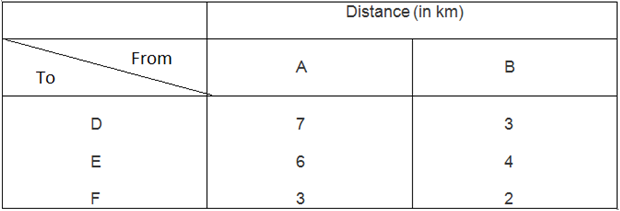
An oil company has two depots$, A$ and $B,$ with capacities of $7000$ litres and $4000$ litres respectively. The company is to supply oil to three petrol pumps, $\text{D, E, F}$ whose requirements are $4500, 3000$ and $3500$ litres respectively. The distance $($in $\ km)$ between the depots and petrol pumps is given in the following table:

Assuming that the transportation cost per km is $Rs. 1.00$ per litre, how should the delivery be scheduled in order that the transportation cost is minimum?
Evaluate the following integrals:
$\int\frac{\text{e}^{\text{3x}}}{4\text{e}^{6\text{x}}-9}\text{dx}$
Show that the four points P, Q, R, S with position vectors $\vec{\text{p}},\ \vec{\text{q}},\ \vec{\text{r}},\ \vec{\text{s}}$ respectively such that $5\vec{\text{p}}-2\vec{\text{q}}+6\vec{\text{r}}-9\vec{\text{s}}=0$, are coplanar. Also, find the position vector of the point of intersection of the line segments PR and QS.
$\int\frac{\text{x}}{\sqrt{\text{x}+4}}\text{dx}$
$\int\frac{\text{x}^2+5\text{x}+2}{\text{x}+2}\text{dx}$
Maximize $Z = x + y$
Subject to $-2\text{x}+\text{y}\leq1$
$\text{x}\leq2$
$\text{x}+\text{y}\leq3$
$\text{x},\text{y}\geq0$
Find the area of the region enclosed by the parabola $x^2=y$ the line $y=x+2$ and $x-$ axis.