MCQ
If six students, including two particular students $A$ and $B,$ stand in a row, then the probability that $A$ and $B$ are separated with one student in between them is
  • A
    $\frac {8}{15}$
  • $\frac {4}{15}$
  • C
    $\frac {2}{15}$
  • D
    $\frac {1}{15}$

Answer

Correct option: B.
$\frac {4}{15}$
b
Consider a group of three students $A, B$ and an other student in between $A$ and $B.$ Choice for a student between $A$ and $B$ is $4.$ $A$ and $B$ can interchange their places in the group in $2$ ways . Now the group of three students (student $A,$ student $B$ and a student in between $A$ and $B$) and the remaining $3$ students can be stand in a row in $4\,!$ ways. Hence total number of ways to stand in a row such that $A$ and $B$ are separated with one student in between them $=4\times 2\times 4\,!$ Now total number of ways to stand $6$ student stand in a row without any restriction $= 6\,!$ Hence required probability $ = \frac{{4 \times 2 \times 4!}}{{6!}} = \frac{{4 \times 2}}{{6 \times 5}} = \frac{4}{{15}}$

Need a full question paper?

Generate a complete, print-ready paper with questions like this in minutes — across 16+ boards, with answer keys.
Start Generating Free

Similar questions

If A and B are two given sets, then $\text{A}\cap\text{(A}\cap\text{B})^\text{c}$ is equal to:
  1. $\text{A}$
  2. $\text{B}$
  3. $\phi$
  4. $\text{A}\cap\text{B}^\text{c}.$
If $|\text{x}| = -5$ then the value of x lies in the interval:
${\left( {\frac{{\sqrt 3 + i}}{2}} \right)^6} + {\left( {\frac{{i - \sqrt 3 }}{2}} \right)^6}$is equal to
If for a hyperbola the ratio of length of conjugate Axis to the length of transverse  axis is $3 : 2$ then the ratio of distance between the focii to the distance between the two directrices is
A ray of light through $(2,1)$ is reflected at a point $P$ on the $y$ - axis and then passes through the point $(5,3)$. If this reflected ray is the directrix of an ellipse with eccentrieity $\frac{1}{3}$ and the distance of the nearer focus from this directrix is $\frac{8}{\sqrt{53}}$, then the equation of the other directrix can be :
If $\frac{{\cos x}}{a} = \frac{{\cos (x + \theta )}}{b} = \frac{{\cos (x + 2\theta )}}{c} = \frac{{\cos (x + 3\theta )}}{d} \, ,$ then $\left( {\frac{{a + c}}{{b + d}}} \right)$ is equal to :-
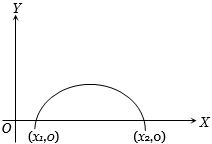
The adjoining figure shows the graph of $y = a{x^2} + bx + c$. Then
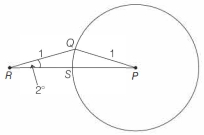
Suppose $Q$ is a point on the circle with centre $P$ and radius $1$, as shown in the figure, $R$ is a point outside the circle such that $Q R=1$ and $\angle Q R P=2^{\circ}$. Let $S$ be the point where the segment $R P$ intersects the given circle. Then, measure of $\angle R Q S$ equals $......^{\circ}$
If z is a complex number, then:
Choose the correct answer. Equation of a circle which passes through $(3,6)$ and touches the axes is: