MCQ
If some charge is given to a solid metallic sphere, the field inside remains zero and by Gauss's law all the charge resides on the surface. Now, suppose that Coulomb's force between two charges varies as $1 / r^{3}$. Then, for a charged solid metallic sphere
  • A
    field inside will be zero and charge density inside will be zero
  • B
    field inside will not be zero and charge density inside will not be zero
  • C
    field inside will not be zero and charge density inside will be zero
  • field inside will be zero and charge density inside will not be zero
Answer

Correct option: D.
field inside will be zero and charge density inside will not be zero
d
$(d)$ As Coulomb's force,

$\quad F \propto \frac{1}{r^{3}}$

$\Rightarrow \text { Electric field, } E \propto \frac{1}{r^{3}} \Rightarrow E=\frac{k q}{r^{3}}$

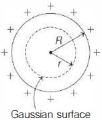
Now, for Gaussian surface $(r < R)$.

Electric flux linked with surface is

$\phi=\int \frac{k q}{r^{3}} \cdot 2 \pi r d r$

$=2 \pi k q \int \frac{d r}{r^{2}}=2 \pi k q\left(-\frac{1}{r}\right)$

As flux is non-zero, charge density is also non-zero. Also, by symmetry of charge distribution electric field is zero.

Need a full question paper?

Generate a complete, print-ready paper with questions like this in minutes — across 16+ boards, with answer keys.

Start Generating Free

Similar questions

In Young's double-slit experiment, a glass plate of refractive index $1.5$ and thickness $5 \times 10^{-4} \,cm$ is kept in the path of one of the light rays. Then
A square metallic wire loop of side $0.1 \,m$ and resistance of $1 \,m$ is moved with a constant velocity in a magnetic field of $2 \,wb/m_2$ as shown in figure. The magnetic field is perpendicular to the plane of the loop, loop is connected to a network of resistances. What should be the velocity of loop so as to have a steady current of $1\,mA$ in loop.......$cm/sec$
Under the influence of a uniform magnetic field a charged particle is moving in a circle of radius $R$ with constant speed $v$. The time period of the motion
Ametal wire is clamped between two vertical walls.At $20 ^o C$ the unstrained length of the wire is exactly equal to the separation between walls. If the temperature of the wire is decreased the graph between elastic energy density $(u)$ and temperature $(T)$ of the wire is
In a Frank-hertz experiment, an electron of energy $5.6\,eV$ passes through mercury vapour and emerges with an energy $0.7\,eV.$ The minimum wavelength of photons emitted by mercury atoms is close to ............. $nm$
Consider the two statements related to circular motion in usual notations

$A$. In uniform circular motion $\vec{\omega}, \vec{v}$ and $\vec{a}$ are always mutually perpendicular

$B$. In non-uniform circular motion, $\vec{\omega}, \vec{v}$ and $\vec{a}$ are always mutually perpendicular

A student determines the velocity of sound with the help of a closed organ pipe. If the observed length for fundamental frequency is $24.7 m$, the length for third harmonic will be  .... $cm$
$A$ particle of mass $m$ is released from $a$ height $H$ on $a$ smooth curved surface which ends into a vertical loop of radius $R$, as shown Choose the correct alternative $(s)$ if $H = 2R$
Work done for the process shown in the figure is ............ $J$
In Young's double slit experiment, carried out with light of wavelength $5000$ $A$, the distance between the slits is $0.3 \mathrm{~mm}$ and the screen is at $200 \mathrm{~cm}$ from the slits. The central maximum is at $x=0 \mathrm{~cm}$. The value of $\mathrm{x}$ for third maxima is ............. $\mathrm{mm}$.