Question
If $\sqrt{2}=1.41$ than $\frac{1}{\sqrt{2}}=?$

Answer

  1. 0.705
    Solution:
    $\frac{1}{\sqrt{2}}=\frac{1}{1.41}=0.705$

Need a full question paper?

Generate a complete, print-ready paper with questions like this in minutes — across 16+ boards, with answer keys.
Start Generating Free

Similar questions

Write the correct answer in the following:
Mode of the data 15, 14, 19, 20, 14, 15, 16, 14, 15, 18, 14, 19, 15, 17, 15 is:
Which one of the following is not equal to $\Big(\frac{100}{9}\Big)^{-\frac{3}{2}}?$
  1. $\Big(\frac{9}{100}\Big)^{\frac{3}{2}}$
  2. $\bigg(\frac{1}{\frac{100}{9}}\bigg)^{\frac{3}{2}}$
  3. $\frac{3}{10}\times\frac{3}{10}\times\frac{3}{10}$
  4. $\sqrt{\frac{100}{9}}\times\sqrt{\frac{100}{9}}\times\sqrt{\frac{100}{9}}$
Every line has:
It is known that if a + b = 4 then a + b + c = 4 + c. The Euclid’s axiom that illustrates this statement is:
In a histogram the area of each rectangle is proportional to:
  1. The class mark of the corresponding class interval.
  2. The class size of the corresponding class interval.
  3. Frequency of the corresponding class interval.
  4. Cumulative frequency of the corresponding class interval.
P is the mid-point of side BC of a parallelogram ABCD such that $\angle\text{BAP}=\angle\text{DAP}.$ If AD = 10cm, then CD =
  1. 5cm.
  2. 6cm.
  3. 8cm.
  4. 10cm.
The coefficient of $x^2$ in the polynomial $2x^3 + 4x^2 + 3x + 1.$
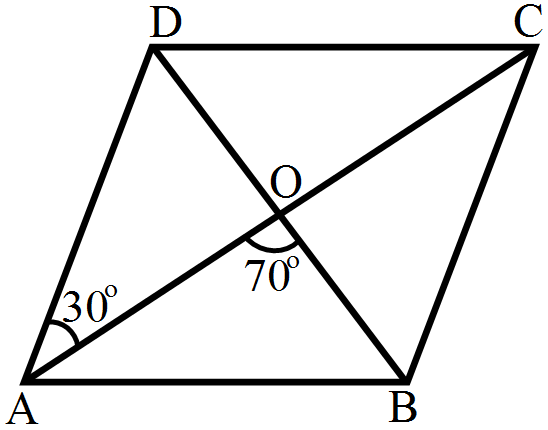
The diagonals AC and BD of a parallelogram ABCD intersect each other at the point Osuch that $\angle\text{DAC}=30^{\circ}$ and $\angle\text{AOB}=70^{\circ}.$ Then, $\angle\text{DBC}=?$
  1. 40°
  2. 35°
  3. 45°
  4. 50°