MCQ
If $t =\sqrt{ x }+4$, then $\left(\frac{ dx }{ dt }\right)_{ t =4}$ is.
  • A
    $4$
  • $0$
  • C
    $8$
  • D
    $16$

Answer

Correct option: B.
$0$
b
$t =\sqrt{ x }+4$

$\Rightarrow x =( t -4)^{2}= t ^{2}-8 t +16$

$\Rightarrow \frac{ dx }{ dt }=2 t -8$

$\left.\Rightarrow \frac{ dx }{ dt }\right|_{ t =4}=2 \times 4-8=0$

Need a full question paper?

Generate a complete, print-ready paper with questions like this in minutes — across 16+ boards, with answer keys.
Start Generating Free

Similar questions

An air compressor is powered by a $200\,rad\,s^{-1}$ electric motor using a $V-$ belt drive. The motor pulley is $8\,cm$ in radius, and the tension in the $V-$ belt is $135\,N$ on one side and $45\,N$ on the other. The power of the motor will be ...... $kW$.
An engine has an efficiency of $0.25$ when temperature of sink is reduced by $58\,^oC$, if its efficiency is doubled, then the temperature of the source is ..... $^oC$
Copper of fixed volume $V$ is drawn into wire of  length $l$. When this wire is subjected to a constant force $F$, the extension produced in the wire is $\Delta l$. Which of the following graphs is a straight line?
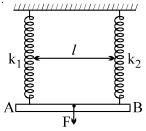
Two light vertical springs with equal natural lengths and spring constants $k_1$ and $k_2$ are separated by a distance $l$. Their upper ends are fixed to the ceiling and their lower ends to the ends $A$ and $B$ of a light horizontal rod $AB$. $A$ vertical downwards force $F$ is applied at point $C$ on the rod. $AB$ will remain horizontal in equilibrium if the distance $AC$ is 
A disc is rolling without slipping on a straight surface. The ratio of its translational kinetic energy to its total kinetic energy is
A particle moves along a parabolic path $y=9 x^2$ in such a way that the $x$ component of velocity remains constant and has a value $\frac{1}{3}\,m / s$. The acceleration of the particle is $.......m / s ^2$
It is true for adiabatic change:
The dimension of $\frac{1}{2} \varepsilon_0 E ^2$, where $\varepsilon_0$ is permittivity of free space and $E$ is electric field, is
A gas is compressed from a volume of $2\,m^3$ to a volume of $1\, m^3$ at a constant pressure of $100\, N/m^2$. Then it is heated at constant volume by supplying $150\, J$ of energy. As a result, the internal energy of the gas
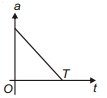
The acceleration (a)-time $(t)$ graph for a particle moving along a straight starting from rest is shown in figure. Which of the following graph is the best representation of variation of its velocity $(v)$ with time $(t)$ ?