MCQ
If $\tan \theta = \frac{{ - 4}}{3},$ then $\sin \theta = $
  • A
    $-4/5$ but not $4/5$
  • $-4/5 $ or $4/5$
  • C
    $4/5$ but not $-4/5$
  • D
    None of these

Answer

Correct option: B.
$-4/5 $ or $4/5$
b
(b) Since ${\rm{cose}}{{\rm{c}}^2}\theta = 1 + {\cot ^2}\theta = 1 + \frac{9}{{16}} = \frac{{25}}{{16}}$

$\left( \because   {\tan \theta  =  - \frac{4}{3}} \right)$

${\sin ^2}\theta = \frac{1}{{{\rm{cose}}{{\rm{c}}^2}\theta }} = \frac{{16}}{{25}} $

$\Rightarrow \sin \theta = \pm \frac{4}{5},$ 

Both the values are acceptable, since $\tan \theta = - \frac{4}{3}\,\,$ 

$\,i.e.,\theta $ lies in ${2^{nd}}$ or ${4^{th}}$ quadrant.

Need a full question paper?

Generate a complete, print-ready paper with questions like this in minutes — across 16+ boards, with answer keys.
Start Generating Free

Similar questions

If the shortest distance between the lines $\frac{x+2}{2}=\frac{y+3}{3}=\frac{z-5}{4}$ and $\frac{x-3}{1}=\frac{y-2}{-3}=\frac{z+4}{2}$ is $\frac{38}{3 \sqrt{5}} \mathrm{k}$ and $\int_0^{\mathrm{k}}\left[\mathrm{x}^2\right] \mathrm{dx}=\alpha-\sqrt{\alpha}$, where $[\mathrm{x}]$ denotes the greatest integer function, then $6 \alpha^3$ is equal to ............................
The minimum number of times a fair coin needs to be tossed, so that the probability of getting at least two heads is at least $0.96$ is
The intercept on the line $y = x$ by the circle ${x^2} + {y^2} - 2x = 0$ is $AB$ . Equation of the circle with $AB$ as a diameter is
If z is a complex number, then the number of common roots of the equation $z^{1985}+z^{100}+1=0$ and $z^3+2 z^2+2 z+1=0$, is equal to :
The function $f(x) = \tan x - x$
If $\alpha$ and $\beta $ are the roots of $6{x^2} - 6x + 1 = 0,$ then the value of $\frac{1}{2}\left[ {\,a + b\alpha + c{\alpha ^2} + d{\alpha ^3}\,} \right]$ $\frac{1}{2}\left[ {\,a + b\alpha + c{\alpha ^2} + d{\alpha ^3}\,} \right] + \frac{1}{2}\left[ {\,a + b\beta + c{\beta ^2} + d{\beta ^3}\,} \right]$ is
The tangent to the hyperbola $xy = c^2$  at the point $P$  intersects the $x-$ axis at $T$ and the $y-$ axis at $T'$. The normal to the hyperbola at $P$ intersects the $ x-$ axis at $N$  and the $y-$ axis at $N'$. The areas of the triangles $PNT$  and $PN'T' $ are $ \Delta$  and $ \Delta ' $ respectively, then $\frac{1}{\Delta }\,\, + \,\,\frac{1}{{\Delta '}}\,$ is
Let $v$ be the solution of the differential equation $\left(1-x^{2}\right) d y=\left(xy+\left(x^{3}+2\right) \sqrt{1-x^{2}}\right) d x,-1 < x < 1$ and $y(0)=0$ if $\int\limits_{-\frac{1}{2}}^{\frac{1}{2}} \sqrt{1-x^{2}} y(x) d x=k$ then $k^{-1}$ is equal to:
If the normal to a parabola $ y^2 = 4ax $ at $P$  meets the curve again in $Q$  and if $PQ $ and the normal at $Q $ makes angles $\alpha$  and $\beta $ respectively with the $x-$ axis then $\tan\,\,\alpha$ ($\tan \alpha + \tan \beta$ ) has the value equal to
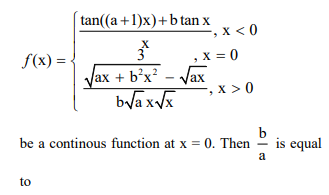
For $a, b > 0,$ let
Image