Question
If $\text{A}=\begin{bmatrix}4&2\\-1&-1 \end{bmatrix},$ prove that (A - 2I)(A - 3I) = 0

Answer

Given, $\text{A}=\begin{bmatrix}4&2\\-1&-1 \end{bmatrix}$
$(\text{A}-2\text{I})(\text{A}-3\text{I})$
$=\begin{pmatrix}\begin{bmatrix}4&2\\-1&-1 \end{bmatrix}-2\begin{bmatrix}1&0\\0&1 \end{bmatrix}\end{pmatrix}\begin{pmatrix}\begin{bmatrix}4&2\\-1&-1 \end{bmatrix}-3\begin{bmatrix}1&0\\0&1 \end{bmatrix} \end{pmatrix}$
$=\begin{pmatrix}\begin{bmatrix}4&2\\-1&-1 \end{bmatrix}-\begin{bmatrix}2&0\\0&2 \end{bmatrix} \end{pmatrix}\begin{pmatrix}\begin{bmatrix}4&2\\-1&-1 \end{bmatrix}-\begin{bmatrix}3&0\\0&3 \end{bmatrix} \end{pmatrix}$
$=\begin{pmatrix}\begin{bmatrix}4-2&2-0\\-1-0&1-2 \end{bmatrix} \end{pmatrix}\begin{pmatrix}\begin{bmatrix}4-3&2-0\\-1-0&1-3 \end{bmatrix} \end{pmatrix}$
$=\begin{bmatrix}2&2\\-1&-1 \end{bmatrix}\begin{bmatrix}1&2\\-1&-2 \end{bmatrix}$
$=\begin{bmatrix}2-2&4-4\\-1+1&-2+2 \end{bmatrix}$
$=\begin{bmatrix}0 & 0 \\0 & 0 \end{bmatrix}$
$=0$
Hence,
$(\text{A}-2\text{I})(\text{A}-3\text{I})=0$

Need a full question paper?

Generate a complete, print-ready paper with questions like this in minutes — across 16+ boards, with answer keys.

Start Generating Free

Similar questions

For the following differntial equations verify that the accompanying function is a solution:
Differential equation Function
$\text{y}=\Big(\frac{\text{dy}}{\text{dx}}\Big)^2$ $\text{y}=\frac{1}{4}(\text{x}\pm\text{a})^2$
A class has 15 students whose ages are 14, 17, 15, 14, 21, 17, 19, 20, 16, 18, 20, 17, 16, 19 and 20 years. One student is selected in such a manner that each has the same chance of being chosen and the age X of the student is recorded. What is the probability distribution of the random variable X? Find mean, variance, and standard deviation of X.
If $\text{A}=\begin{bmatrix}1&2&2\\2&1&2\\2&2&1\end{bmatrix},$ then prove that $A^2 - 4A - 5I = 0.$
Find the area of the region in the first quadrant bounded by the circle $x^2+y^2=4$ and the

X-axis and the line x = y√3.

Prove the following identities:
$\begin{vmatrix}\text{a}+\text{x}&\text{y}&\text{z}\\\text{x}&\text{a}+\text{y}&\text{z}\\\text{x}&\text{y}&\text{a}+\text{z}\end{vmatrix}=\text{a}^2(\text{a}+\text{x}+\text{y}+\text{z})$
Classify the following functions as injection, surjection or bijection:f: $Q \rightarrow Q$, defined by $f(x)=x^3+1$
Show that the four points P, Q, R, S with position vectors $\vec{\text{p}},\ \vec{\text{q}},\ \vec{\text{r}},\ \vec{\text{s}}$ respectively such that $5\vec{\text{p}}-2\vec{\text{q}}+6\vec{\text{r}}-9\vec{\text{s}}=0$, are coplanar. Also, find the position vector of the point of intersection of the line segments PR and QS.
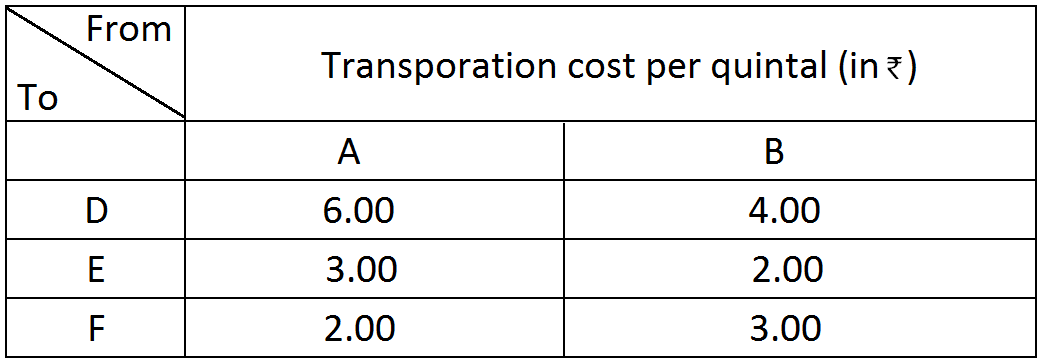
Tow godowns, $A$ and $B,$ have grain storage capacity of $100$ quintals and $50$ quintals respectively. They supply to $3$ ration shops, $D, E$ and $F$, whose requirements are $60, 50$ and $40$ quintals respectively. The cost of transportation per quintal from the godowns to the shops are given in the following table:


How should the supplies be transported in order that the transportation cost is minimum?
Find the vector and cartesian equation of the line through the point (5, 2, -4) and which is parallel to the vector $3\hat{\text{i}}+2\hat{\text{j}}-8\hat{\text{k}}.$
Given that the two numbers appearing on throwing two dice are different. Find the probability of the event 'the sum of numbers on the dice is 4'.