MCQ
If $\text{a}\cos\theta-\text{b}\sin\theta=\text{c},$ then $\text{a}\sin\theta+\text{b}\cos\theta=$
  • A
    $\pm\sqrt{\text{a}^2+\text{b}^2+\text{c}^2}$
  • $\pm\sqrt{\text{a}^2+\text{b}^2-\text{c}^2}$
  • C
    $\pm\sqrt{\text{c}^2-\text{a}^2-\text{b}^2}$
  • D
    None of these.

Answer

Correct option: B.
$\pm\sqrt{\text{a}^2+\text{b}^2-\text{c}^2}$
Squaring,
$\text{a}^2\cos^2\theta+\text{b}^2\sin^2\theta-2\text{ab}\sin\theta\cos\theta=\text{c}^2$
$\Rightarrow\ \text{a}^2(1-\sin^2\theta)+\text{b}^2(1-\cos^2\theta)-2\text{ab}\sin\theta\cos\theta=\text{c}^2$
$\Rightarrow\ \text{a}^2-\text{a}^2\sin^2\theta+\text{b}^2(1-\cos^2\theta)-2\text{ab}\sin\theta\cos\theta=\text{c}^2$
$\Rightarrow\ -\text{a}^2\sin^2\theta-\text{b}^2\cos^2\theta-2\text{ab}\sin\theta\cos\theta=\text{c}^2-\text{a}^2-\text{b}^2$
$\Rightarrow\ \text{a}^2\sin^2\theta+\text{b}^2\cos\theta+2\text{ab}\sin\theta\cos\theta=\text{a}^2+\text{b}^2-\text{c}^2 $
$\ (\text{Dividing by}-1)$
$(\text{a}\sin\theta+\text{b}\cos\theta)^2=\text{a}^2+\text{b}^2-\text{c}^2$
$\therefore\ \text{a}\sin\theta+\text{b}\cos\theta=\pm\sqrt{\text{a}^2+\text{b}^2-\text{c}^2}$

Need a full question paper?

Generate a complete, print-ready paper with questions like this in minutes — across 16+ boards, with answer keys.

Start Generating Free

Similar questions

A number when divided by $143$ leaves $31$ as remainder. What will be the remainder when the same number is divided by $13?$
A number is selected at random from the numbers $1$ to $30.$ The probability that it is a prime number is:
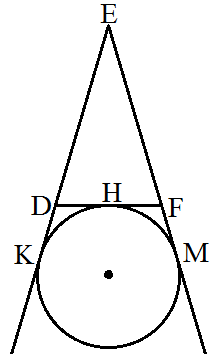
In the figure, a circle touches the side $\text{DF}$ of $\triangle\text{EDF}$ at $H$ and touches $\text{ED}$ and $\text{EF}$ produced at $K$ and $M$ respectively. If $\text{EK} = 9\ cm,$ then the perimeter $\triangle\text{EDF}$ of is:
A box contains $3$ blue, $2$ white and $4$ red marbles. If a marble is drawn at random from the box, what is the probability that it will not be a white marble?
Choose the correct alternative answer for each of the following question.
The curved surface area of a cylinder is $440 \mathrm{~cm}^2$ and its radius is $5 \ cm.$ Find its height.
$\text{ABCD}$ is a trapezium such that $\ce{BC \| AD}$ and $\text{AD} = 4\ cm$. If the diagonals $\text{AC}$ and $\text{BD}$ intersect at $O$ such that $\frac{\text{AO}}{\text{OC}}=\frac{\text{DO}}{\text{OB}}=\frac{1}{2},$ then $\text{BC} =$
Four alternative answers for each of the following questions are given. Choose the correct alternative.
∠ ACB is inscribed in arc ACB of a circle with centre O. If ∠ ACB = 65°,find m(arc ACB).
A. 65°
B. 130°
C. 295°
D. 230°
On increasing the radii of the base and the height of a cone by $20\%,$ its volume will increase by:
The sum of first 10 natural number is ______
Select pair of simultaneous equations from the following _____ .
(1) $2 x+2 y=7$ (2) $4 x+3 z=9$
(3) $3 y+4 z=8$ (4) $3 z+9 x=18$