Question
If $\text{f(x)}=\begin{cases}\frac{\cos^2\text{x}-\sin^2\text{x}}{\sqrt{\text{x}^2+1}-1},&\text{x}\neq0\\\text{k},&\text{x}=0\end{cases}$ is continuous at x = 0, find k.

Answer

Given,
$\text{f(x)}=\begin{cases}\frac{\cos^2\text{x}-\sin^2\text{x}}{\sqrt{\text{x}^2+1}-1},&\text{x}\neq0\\\text{k},&\text{x}=0\end{cases}$
If f(x) is continuous at x = 0, then
$\lim_\limits{\text{x}\rightarrow 0}\text{f(x)}=\text{f}(0)$
$\Rightarrow\lim_\limits{\text{x}\rightarrow 0}\frac{\cos^2\text{x}-\sin^2\text{x}}{\sqrt{\text{x}^2+1}-1}=\text{k}$
$\Rightarrow\lim_\limits{\text{x}\rightarrow 0}\frac{1-\sin^2\text{x}-\sin^2\text{x}-1}{{\sqrt{\text{x}^2+1}-1}}=\text{k}$
$\Rightarrow\lim_\limits{\text{x}\rightarrow 0}\frac{-2\sin^2\text{x}}{{\sqrt{\text{x}^2+1}-1}}=\text{k}$
$\Rightarrow\lim_\limits{\text{x}\rightarrow 0}\frac{-2(\sin^2\text{x})\big({\sqrt{\text{x}^2+1}+1}\big)}{\big({\sqrt{\text{x}^2+1}-1}\big)\big({\sqrt{\text{x}^2+1}+1}\big)}=\text{k}$
$\Rightarrow\lim_\limits{\text{x}\rightarrow 0}\frac{-2(\sin^2\text{x})\big({\sqrt{\text{x}^2+1}+1}\big)}{\text{x}^2}=\text{k}$
$\Rightarrow-2\lim_\limits{\text{x}\rightarrow 0}\frac{(\sin^2\text{x})\big({\sqrt{\text{x}^2+1}+1}\big)}{\text{x}^2}=\text{k}$
$\Rightarrow-2\lim_\limits{\text{x}\rightarrow 0}\Big(\frac{\sin\text{x}}{\text{x}}\Big)^2\lim_\limits{\text{x}\rightarrow 0}\Big({\sqrt{\text{x}^2+1}-1}\Big)$
$\Rightarrow-2\times-1\times(1+1)=\text{k}$
$\Rightarrow\text{k}=-4$

Need a full question paper?

Generate a complete, print-ready paper with questions like this in minutes — across 16+ boards, with answer keys.
Start Generating Free

Similar questions

Let $\text{A}=\begin{bmatrix}3 & 2&7 \\1 & 4&3\\-2&5&8 \end{bmatrix}.$ Find matrices X and Y such that X + Y = A, where X is a symmetric and Y is a skew-symmetric matrix.
Verify Rolle's theorem of the following function on the indicated interval
$\text{f}(\text{x})=\sin\text{x}-\sin2\text{x}\text{ on }[0,\pi]$
Find the points of local maxima or local minima and corresponding local maximum and local minimum values of the following functions. Also, find the points of inflection,
$f(x) = (x - 1)(x - 2)^2$​​​​​​​
If $\cos\text{y}=\text{x}\cos(\text{a}+\text{y}),$ with $\cos\text{a}\neq\pm1,$ prove that $\frac{\text{dy}}{\text{dx}}=\frac{\cos^2(\text{a}+\text{y})}{\sin\text{a}}$
If $e^x + x^y = e^{x+y}$​​​​​​​, prove that $\frac{\text{dy}}{\text{dx}}+\text{e}^{\text{y}-\text{x}}=0$
Evaluate the following intregals:
$\int\frac{1}{1-\sin\text{x}+\cos\text{x}}\ \text{dx}$
Solve the following differential equation:$\frac{\text{dy}}{\text{dx}}+\text{y}=\text{e}^{-2\text{x}}$
If O is the origin and the coordinates of A are (a, b, c) Find the direction cosines of OA and the equation of the plane through A at right angles to OA.
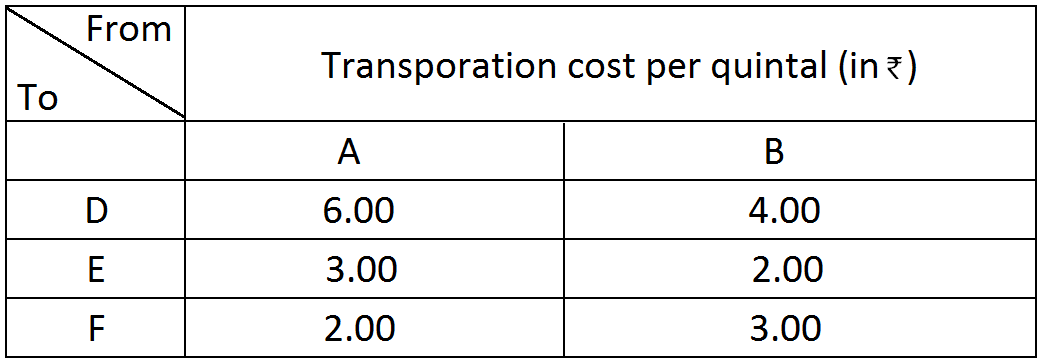
Tow godowns, $A$ and $B,$ have grain storage capacity of $100$ quintals and $50$ quintals respectively. They supply to $3$ ration shops, $D, E$ and $F$, whose requirements are $60, 50$ and $40$ quintals respectively. The cost of transportation per quintal from the godowns to the shops are given in the following table:


How should the supplies be transported in order that the transportation cost is minimum?
Find the approximate value of $log_{10} 1005$, given that $log_{10} e = 0.4343.$