Question
If $\text{f(x)}=\log_\text{e}(1-\text{x})$ and $\text{g(x)}=[\text{x}],$ then determine the following functions:
$\frac{\text{f}}{8}$

Answer

We have,
$\text{f(x)}=\log_\text{e}(1-\text{x})$
and $\text{g(x)}=[\text{x}]$
$\text{f(x)}=\log_\text{e}(1-\text{x})$ is defined, if 1 - x > 0
$\Rightarrow1>\text{x}$
$\Rightarrow\text{x}<1$
$\Rightarrow\text{x}\in(-\infty,1)$
$\therefore\text{ Domain(f)}=(-\infty,1)$
$\text{g(x)}=[\text{x}]$ is defined for all $\text{x}\in\text{R}$
$\therefore\ \text{Domain(g)}=\text{R}$
$\therefore\ \text{Domain(f)}\cap\text{R}\text{ Domain(g)}=(-\infty,1)\cap\text{R}$
$=(-\infty,1)$
$\text{g(x)}=[\text{x}]$
$\therefore\ [\text{x}]=0$
$\Rightarrow\text{x}\in(0,1)$
So, domain $\Big(\frac{\text{f}}{\text{g}}\Big)=\text{domain(f)}\cap\text{domain(g)}-\{\text{x}:\text{g(x)}=0\}$
$\therefore\ \frac{\text{f}}{\text{g}}:(-\infty,0)\rightarrow\text{R}$ defined by $\Big(\frac{\text{f}}{\text{g}}\Big)(\text{x})=\frac{\log_\text{e}(1-\text{x})}{[\text{x}]}$

Need a full question paper?

Generate a complete, print-ready paper with questions like this in minutes — across 16+ boards, with answer keys.
Start Generating Free

Similar questions

Find $\mathrm{k}$ if the following function is continuous at the point indicated against them:
$
\left.\begin{array}{rl}
f(x)=\frac{45^x-9^2-5^x+1}{\left(k^2-1\right)\left(3^2-1\right)}, & \text { for } x \neq 0 \\
=\frac{2}{3}, & \text { for } x=0
\end{array}\right\} \text { at } \mathrm{x}=0
$
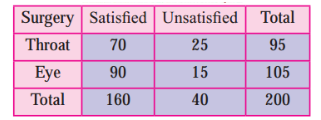
Two hundred patients who had either Eye surgery or Throat surgery were asked whether they were satisfied or unsatisfied regarding the result of their surgery. The following table summarizes their response.

Image

If one person from the 200 patients is selected at random, determine the probability (a) that the person was satisfied given that the person had Throat surgery.

2.that person was unsatisfied given that the person had eye surgery.

3.the person had Throat surgery given that the person was unsatisfied.

Compute variance and standard deviation for the following data :

Image

If then $\text{x}+\tan\Big(\frac{\pi}{3}\Big)+\tan\Big(\text{x}=\frac{2\pi}{3}\Big)=3,$prove that $\frac{3\tan\text{x}-\tan^3\text{x}}{1-3\tan^2\text{x}}=1$
Tangents to the circle $x^2+y^2=a^2$ with inclinations, $\theta_1$ and $\theta_2$ intersect in $P$. Find the locus of P such that

1.$\tan \theta_1+\tan \theta_2=0$

2. $\cot \theta_1+\cot \theta_2=5$

3. $\cot \theta_1 \cdot \cot \theta_2=c$

Show that the path of a moving point such that its distances from two lines 3x - 2y = 5 and 3x + 2y = 5 are equal is a straight line.
Find the equation of an ellipse, the distance between the foci is 8 units and the distance between the directrices is 18 units.
Find the equation of the ellips whose focus is (1, -2), the directrix $3\text{x}-2\text{y}+5=0$ and eccentricity equal to $\frac{1}{2}$
Sum the following series to $n$ terms:
$\frac{1}{1.4}+\frac{1}{4.7}+\frac{1}{7.10}+\ .....$
Find the equation of the straight line perpendicular to $2x - 3y = 5$ and cutting off an intercept $1$ on the positive direction of the $x-$axis.