MCQ
If $\text{f(x)}=\sqrt{1-\sqrt{1-\text{x}^2}},$ then f(x) is:
  • A
    Continuous on [-1, 1] and differentiable on (-1, 1)
  • Continuous on [-1, 1] and differentiable on $(-1,0)\cup(0,1)$
  • C
    Continuous and differentiable on [-1, 1]
  • D
    None of these.

Answer

Correct option: B.
Continuous on [-1, 1] and differentiable on $(-1,0)\cup(0,1)$
We have,
$\text{f(x)}=\sqrt{1-\sqrt{1-\text{x}^2}}$
Here, function will be defined for those values of x for which
$1-\text{x}^2\geq0$
$\Rightarrow1\geq\text{x}^2$
$\Rightarrow\text{x}^2\leq1$
$\Rightarrow|\text{x}\leq1|$
$\Rightarrow-1\leq\text{x}\leq1$
Therefore, function is continuous in -1, 1
Now, we need to check the differentiability of $\text{f(x)}=\sqrt{1-\sqrt{1-\text{x}^2}}$ in the interval -1, 1
Now,
We will check the differentiable at x = 0
LHL at x = 0
$=\lim\limits_{\text{x}\rightarrow\infty}\frac{\text{f(x)}-\text{f}(0)}{\text{x}-0}$
$=\lim\limits_{\text{x}\rightarrow\infty}\frac{\sqrt{1-\sqrt{1-\text{x}^2}}-0}{\text{x}}$
$=\lim\limits_{\text{x}\rightarrow\infty}\frac{\sqrt{1-\sqrt{1-\text{x}^2}}}{\text{x}}$
$=\lim\limits_{\text{h}\rightarrow0}\frac{\sqrt{1-\sqrt{1-(0-\text{h})^2}}}{0-\text{h}}$
$=\lim\limits_{\text{h}\rightarrow0}\frac{\sqrt{1-\sqrt{1-\text{h}^2}}}{-\text{h}}$
$=-\infty$
RHL at x = 0
$=\lim\limits_{\text{x}\rightarrow0^{+}}\frac{\text{f(x)}-\text{f}(0)}{\text{x}-0}$
$=\lim\limits_{\text{x}\rightarrow0^{+}}\frac{\sqrt{1-\sqrt{1-\text{x}^2}}-0}{\text{x}}$
$=\lim\limits_{\text{h}\rightarrow0}\frac{\sqrt{1-\sqrt{1-(0+\text{h})^2}}}{0+\text{h}}$
$=\lim\limits_{\text{h}\rightarrow0}\frac{\sqrt{1-\sqrt{1-\text{h}^2}}}{\text{h}}$
$=\infty$
So, the function is not differentiable at x = 0.

Need a full question paper?

Generate a complete, print-ready paper with questions like this in minutes — across 16+ boards, with answer keys.
Start Generating Free

Similar questions

If $\vec{\text{a}}$ and $\vec{\text{b}}$ are unit vectors,then the greatest value of $\sqrt{3}\big|\vec{\text{a}}+\vec{\text{b}}\big|+\big|\vec{\text{a}}-\vec{\text{b}}\big|$ is :
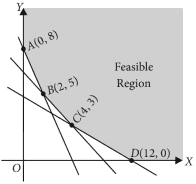
Feasible region for an L.P.P. is shown shaded in the following figure. Minimum of $Z=5 x+3 y$ occurs at the point point
Image
An angle between the lines whose direction cosines are given by the equations, $l+ 3m + 5n\, = 0$ and $5lm -2mn + 6nl = 0$ , is
If R is a relation on the set A = {1, 2, 3} given by R = {(1, 1), (2, 2), (3, 3)}, then R is:
If $a \ne b \ne c,$ the value of $x$ which satisfies the equation $\left| {\,\begin{array}{*{20}{c}}0&{x - a}&{x - b}\\{x + a}&0&{x - c}\\{x + b}&{x + c}&0\end{array}\,} \right| = 0$, is
A particle starts at the origin and moves along the $x$-axis in such a way that its velocity at the point $(x, 0)$ is given by the formula $\frac{{dx}}{{dt}} = {\cos ^2}\pi x.$ Then the particle never reaches the point on
Distance of the point $(1, 2, 3)$ from the co-ordinate axes are
The area of the region bounded by the parabola $(y - 2)^2 = x - 1,$ the tangent to it at the point with the ordinate $3$ and the $x-$ axis is:
Let $X_n=\{1,2,3, \ldots, n\}$ and let a subset $A$ of $X_n$ be chosen so that every pair of elements of $A$ differ by at least 3. (For example, if $n=5, A$ can be $\phi,\{2\}$ or $\{1,5\}$ among others). When $n=10$, let the probability that $1 \in A$ be $p$ and let the probability that $2 \in A$ be Then,
Which of the following is the integrating factor of $(\text{x}\log\text{x})\frac{\text{dy}}{\text{dx}}+\text{y}=2\log\text{x}?$