MCQ
If $\text{V}=\frac{4}{3}\pi\text{r}^3,$ at What rate in cubic units is V increasing when $\text{r}=10\frac{\text{dr}}{\text{dt}}=0.01?$
  • A
    $\pi$
  • $4\pi$
  • C
    $40\pi$
  • D
    $4=\frac{\pi}{3}$

Answer

Correct option: B.
$4\pi$
Given: $\text{V}=\frac{4}{3}\pi\text{r}^3,\text{and } \frac{\text{dr}}{\text{dt}}=0.01$
$\frac{\text{dV}}{\text{dt}}=4\pi\text{r}^2\frac{\text{dr}}{\text{dt}}$

$\frac{\text{dV}}{\text{dt}}=4\pi(10)^2\times0.01$

$\frac{\text{dV}}{\text{dt}}=4\pi$

Need a full question paper?

Generate a complete, print-ready paper with questions like this in minutes — across 16+ boards, with answer keys.
Start Generating Free

Similar questions

Find area bounded by curves $\{(\text{x},\text{y}):\text{y}\geq\text{x}^2$ andy$=\text{x}\} :$
If $2{\tan ^{ - 1}}(\cos x) = {\tan ^{ - 1}}(2{\rm{cosec }}x),$ then  $x =$
The general solution of the differential equation $\left(x-y^{2}\right) d x+y\left(5 x+y^{2}\right) d y=0$ is.
Let $A = \{1, 2, 3\}$ and consider the relation $R = \{(1, 1), (2, 2), (3, 3), (1, 2), (2, 3), (1, 3)\}.$ Then, $R$ is:
The solution set of inequality $\left( {{{\tan }^{ - 1}}x} \right)\left( {{{\cot }^{ - 1}}x} \right) - \left( {{{\tan }^{ - 1}}x} \right)\left( {1 + \frac{\pi }{2}} \right) - 2{\cot ^{ - 1}}x + 2\left( {1 + \frac{\pi }{2}} \right)\,$$ > \mathop {\lim }\limits_{x \to \infty } \left[ {{{\sec }^{ - 1}}x - \frac{\pi }{2}} \right]\,$ is (where [.] denotes the greatest integer function)
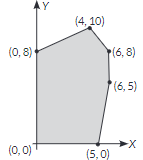
In the given graph, the feasible region for a LPP is shaded. The objective function $Z=2 x-3 y$, will be minimum at
Image
$\tan \left[ {\frac{1}{2}{{\cos }^{ - 1}}\left( {\frac{{\sqrt 5 }}{3}} \right)} \right] = $
Let $A = \left( {\begin{array}{*{20}{c}}1&{ - 1}&1\\2&1&{ - 3}\\1&1&1\end{array}} \right)$ and $(10)B = \left( {\begin{array}{*{20}{c}}4&2&2\\{ - 5}&0&\alpha \\1&{ - 2}&3\end{array}} \right)$. If $B$ is the inverse of matrix $A$, then $\alpha $ is
If $A$ and $B$ are matrices of the same order, then $A B^{\top}-B A^{\top}$ is a :
Directions: In the following questions, the Assertions $(A)$ and Reason$(s)\ (R)$ have been put forward. Read both the statements carefully and choose the correct alternative from the following:
Assertion $(A)$ if $\text{y}=\tan5\text{x}^\circ,$ then $\frac{\text{dy}}{\text{dx}}=\frac{5\pi}{180}\sec^2(5\text{x}^\circ)$
Reason$(R) \pi^\text{c}=90^\circ$