Question
If $\text{x}=\frac{\sqrt3+1}{2},$ find the value of $4\text{x}^3+2\text{x}^2-8\text{x}+7.$

Answer

We have, $\text{x}=\frac{\sqrt3+1}{2}$ It can be simplified as $2\text{x}-1=\sqrt3$ On squaring both sides,
we get $(2\text{x}-1)^2=\big(\sqrt3\big)^2$
$(2\text{x})^2+1-2\times2\text{x}=3$
$4\text{x}^2+1-4\text{x}=3$
$4\text{x}^2-4\text{x}-2=0$
The given equation can be rewritten as. $4\text{x}^3+2\text{x}^2-8\text{x}+7$
$\ =\text{x}(4\text{x}^2-4\text{x}-2)+\frac{6}{4}(4\text{x}^2-4\text{x}-2)+3+7$
Therefore, we have $4\text{x}^3+2\text{x}^2-8\text{x}+7=\text{x}(0)+\frac{6}{4}(0)+3+7$
$=3+7$
$=10$
Hence, the value of given expression is $10.$

Need a full question paper?

Generate a complete, print-ready paper with questions like this in minutes — across 16+ boards, with answer keys.

Start Generating Free

Similar questions

If the polynomials $a x^3+3 x^2-13$ and $2 x^3-5 x+a$, when divided by $(x-2)$ leave the same remainder, Find the value of a.
The barrel of a fountain pen, cylindrical in shape, is $7cm$ long and $5mm$ in diameter. A full barrel of ink in the pen will be used up on writing $330$ words on an average. How many words would use up a bottle of ink containing one fifth of a litre?
$ABCD$ is a rhombus in which altitude from $D$ to side $AB$ bisects $AB$. Find the angles of the rhombus.
An open box is made of wood $3\ cm$ thick. Its external length, breadth and height are $1.48\ m$, $1.16\ m$ and $8.3\ dm$. Find the cost of painting the inner surface of ₹ $50$ per sq. metre.
The following table shows the daily production of $T.V.$ sets in an industry for $7$ days of a week:
Day
Mon
Tue
Wed
Thurs
Fri
Sat
Sun
Number of T.V. Sets
$300$
$400$
$150$
$250$
$100$
$350$
$200$
Represent the above information by a pictograph.
Prove that the line segment joining the mid-point of the hypotenuse of a right triangle to its opposite vertex is half of the hypotenuse.
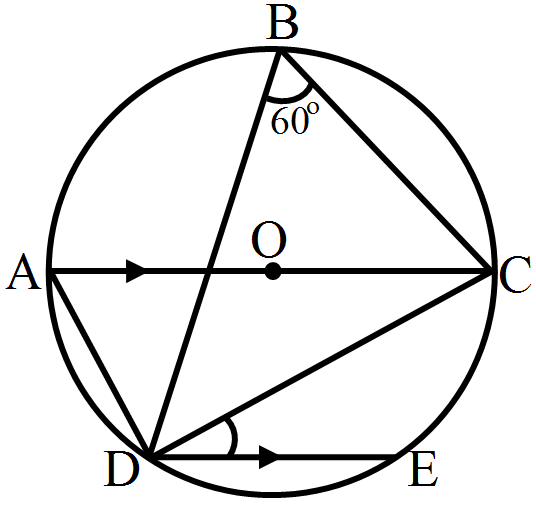
In the adjoining figure, $DE$ is a chord parallel to diameter $AC$ of the circle with centre $O$. If $\angle\text{CBD}=60^\circ,$calculate $\angle\text{CDE}.$
In a rhombus ABCD show that diagonal AC bisects $\angle\text{A}$ as well as $\angle\text{C}$ and diagonal BD bisects $\angle\text{B}$ as well as $\angle\text{D}.$
In the following, using the remainder theorem, find the remainder when $f(x)$ is divided by $g(x)$ and verify the by actual division: $f(x) = 2x^4 - 6x^3 + 2x^2 - x + 2, g(x) = x + 2$