Question
If $\text{y}=\tan^{-1}\Big(\frac{1-\text{x}}{1+\text{x}}\Big),$, find $\frac{\text{dy}}{\text{dx}}.$

Answer

Here,
$\text{y}=\tan^{-1}\Big(\frac{1-\text{x}}{1+\text{x}}\Big)$
Differentiating it with respect to x using chain rule and quotinet rule,
$\frac{\text{dy}}{\text{dx}}=\frac{1}{1+\big(\frac{1-\text{x}}{1+\text{x}}\big)^2}\frac{\text{d}}{\text{dx}}\Big(\frac{1-\text{x}}{1+\text{x}}\Big)$
$=\frac{(1+\text{x})^2}{(1+\text{x}^2+2\text{x}+1+\text{x}^2-2\text{x})}\bigg[\frac{(1+\text{x})\frac{\text{d}}{\text{dx}}(1-\text{x})-(1-\text{x})\frac{\text{d}}{\text{dx}}(1+\text{x})}{(1+\text{x})^2}\bigg]$
$=\frac{(1+\text{x})^2}{2\text{x}^2+2}\Big[\frac{(1+\text{x})(-1)-(1-\text{x})(1)}{(1+\text{x})^2}\Big]$
$=\frac{(1+\text{x})^2}{2(\text{x}^2+1)}\Big(\frac{-\text{x}-1-1+\text{x}}{(1+\text{x})^2}\Big)$
$=\frac{(1+\text{x})^2}{2(\text{x}^2+1)}\times\frac{-2}{(1+\text{x})^2}$
$\frac{\text{dy}}{\text{dx}}=-\frac{1}{\text{x}^2+1}$

Need a full question paper?

Generate a complete, print-ready paper with questions like this in minutes — across 16+ boards, with answer keys.
Start Generating Free

Similar questions

Show that:
$\begin{vmatrix}\text{y}+\text{z}&\text{x}&\text{y}\\\text{z}+\text{x}&\text{z}&\text{x}\\\text{x}+\text{y}&\text{y}&\text{z}\end{vmatrix}=(\text{x}+\text{y}+\text{z})(\text{x}-\text{z})^3$

Image
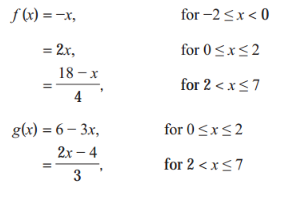
Let u(x) = f[g(x)], v(x) = g[f(x)] and w(x) = g[g(x)]. Find each derivative at x = 1, if it exists i.e. find u'(1), v'(1) and w'(1). if it doesn’t exist then explain why?
Using differentials, find the approximate values of the following:$\frac{1}{\sqrt{25.1}}$
Find the equation of a plane which passes through the point (3, 2, 0) and contains the line $\frac{\text{x}-3}{1}=\frac{\text{y}-6}{5}=\frac{\text{z}-4}{4}$
Find the equation of the lines joining the following pairs of vertices and then find the shortest distance between the lines(1) (0, 0, 0) and (1, 0, 2)
(2) (1, 3, 0) and (0, 3, 0)
Check the commutativity and associativity of the following binary operations:
'*' on N defined by a * b = gcd(a, b) for all a, b ∈ N.
Find the points o local maxima or local minima, if any, of the following functions, using the first derivatives test. Also, find the local maximum or local minimum values, as the case may be:$f(x) = (x - 1)(x + 2)^2$​​​​​​​
Find the equation of the plane through the intersection of the planes 3x - 4y + 5z = 10 and 2x + 2y - 3z = 4 and parallel to the line x = 2y = 3z.
Evaluate the following integrals:$\int^\limits{1}_0\big(\cos^{-1}\text{x}\big)^2\text{dx}$
If a unit vector $\vec{\text{a}}$ makes an angle $\frac{\pi}3$ with $\hat{\text{i}}$, $\frac{\pi}4$ with $\hat{\text{j}}$ and an acute angle $\theta$ with $\hat{\text{k}}$, then find $\theta$ and hence, the components of $\vec{\text{a}}$.