MCQ
If the capacitors in the previous question are joined in parallel, the capacitance and the breakdown voltage of the combination will be:
  • A
    $2C$ and $2V$
  • B
    $C$ and $2V$
  • $2C$ and $V$
  • D
    $C$ and $V$

Answer

Correct option: C.
$2C$ and $V$

In a parallel combination of capacitors, the potential difference across the capacitors remain the same, as the righthand-side plates and the left$-$hand$-$side plates of both the capacitors are connected to the same terminals of the battery. Therefore, the potential remains the same, that is, $V.$
For the parallel combination of capacitors, the capacitance is given by
$C_{\text {eq }}=C_1+C_2$
Here,
$C_1=C_2=C$
$\therefore C_{e q}=2 C$

Need a full question paper?

Generate a complete, print-ready paper with questions like this in minutes — across 16+ boards, with answer keys.
Start Generating Free

Similar questions

A simple pendulum of period $T$ has a metal bob which is negatively charged. If it is allowed to oscillate above a positively charged metal plate, its period will
Force between two point charges $q_1$ and $q_2$ placed in vacuum at ' $r$ ' $\mathrm{cm}$ apart is $F$. Force between them when placed in a medium having dielectric $\mathrm{K}=5$ at $\mathrm{r} / 5$ $\mathrm{cm}$ apart will be:
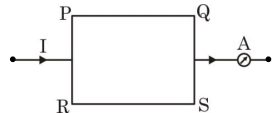
A current carrying rectangular loop PQRS is made of uniform wire. The length $PR = QS =5\,cm$ and $PQ = RS =100\,cm$. If ammeter current reading changes from I to $2 I$, the ratio of magnetic forces per unit length on the wire $P Q$ due to wire RS in the two cases respectively $f_{ PQ }^{ I }: f_{ PQ }^{2 I }$ is :
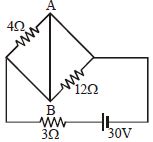
Considering the following circuit, select the correct alternative
Potential at a point x-distance from the centre inside the conducting sphere of radius R and charged with charge Q is 
If $_i{\mu _j}$ represents refractive index when a light ray goes from medium $i$ to medium $j,$ then the product $_2{\mu _1} \times {\,_3}{\mu _2} \times {\,_4}{\mu _3}$ is equal to
Two parallel wires of length $9 m$ each are separated by a distance $0.15 m$. If they carry equal currents in the same direction and exerts a total force of $30 \times 10^{-7} N$ on each other, then the value of current must be
A beam of well collimated cathode rays travelling with a speed of $5 \times {10^6}\,m{s^{ - 1}}$ enter a region of mutually perpendicular electric and magnetic fields and emerge undeviated from this region. If $| B |=0.02\; T$, the magnitude of the electric field is
The decay constant $\lambda $ of the radioactive sample is the probability of decay of an atom in unit time, then
An object approaches a convergent lens from the left of lens with a uniform speed $5\, m/s$ and stops at the focus. The image :-