MCQ
If the dimensions of a physical quantity are given by $M^aL^bT^c$ ,then physical quantity will be 
  • A
    velocity if  $a=1,b=0,c=-1$
  • B
    acceleration if  $a=1,b=1,c=-2$
  • C
    force if $a=0,b=-1,c=-2$
  • pressure if $a=1,b=-1,c=-2$

Answer

Correct option: D.
pressure if $a=1,b=-1,c=-2$
d
Pressure, $p = \frac{{force}}{{area}} = \frac{{mass\, \times \,acceleration}}{{area}}$
$\therefore \,\left[ P \right] = \frac{{{M^1}L{T^{ - 2}}}}{{{L^2}}} = \left[ {{M^1}{L^{ - 1}}{T^{ - 2}}} \right] = \,{M^a}{L^b}{T^c}$
$\therefore \,a = 1,\,b =  - 1,\,c =  - 2.$

Need a full question paper?

Generate a complete, print-ready paper with questions like this in minutes — across 16+ boards, with answer keys.
Start Generating Free

Similar questions

Consider a thin spherical shell of radius $R$ with its centre at the origin, carrying uniform positive surface charge density. The variation of the magnitude of the electric field $|\vec{E}(r)|$ and the electric potential $V(r)$ with the distance r from the centre, is best represented by which graph?
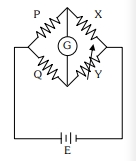
A wheatstone bridge is used to determine the value of unknown resistance $X$ by adjusting the variable resistance $Y$ as shown in the figure. For the most precise measurement of $X$, the resistances $P$ and $Q$:
Consider the two idealised systems $(i)$ a parallel plate capacitor with large plates and small separation and $(ii)$ a long solenoid of length $L >> R$, radius of cross-section. In $(i)\, E$ ideally treated as a constant between plates and zero outside. In $(ii)$ magnetic field is constant inside the solenoid and zero outside. These idealised assumptions, however, contradict fundamental laws as below
The magnetic flux linked with coil, in weber is given by the equation, $\phi = 5{t^2} + 3t + 16$. The induced emf in the coil in the fourth second is.....$V$
Consider a binary star system of star $A$ and star $B$ with masses $m_{A}$ and $m_{B}$ revolving in a circular orbit of radii $r_{A}$ and $r_{B}$, respectively. If $T_{A}$ and $T_{B}$ are the time period of star $A$ and star $B$, respectively, then -
A $LCR$ circuit behaves like a damped harmonic oscillator. Comparing it with a physical springmass damped oscillator having damping constant $\mathrm{b}$, the correct equivalence would be:
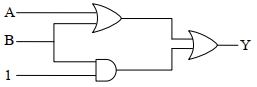
The output $(\mathrm{Y})$ of logic circuit given below is $0$ only when:
The Boolean expression $P +\overline{ P } Q$, where $P$ and $Q$ are the inputs of the logic circuit, represents
An ideal gas is in thermodynamic equilibrium. The number of degrees of freedom of a molecule of the gas in $n$. The internal energy of one mole of the gas is $U_n$ and the speed of sound in the gas is $v_n$. At a fixed temperature and pressure, which of the following is the correct option?
The specific resistance of a wire is $\rho $, its volume is $3\,{m^3}$ and its resistance is $3\, ohms$, then its length will be