If the displacement equation of a particle be represented by $y = A\sin PT + B\cos PT$, the particle executes
Easy


Download our appand get started for free
Experience the future of education. Simply download our apps or reach out to us for more information. Let's shape the future of learning together!No signup needed.*
Similar Questions
- 1A particle is executing $SHM$ of amplitude $A,$ about the mean position $x = 0.$ Which of the following cannot be a possible phase difference between the positions of the particle at $x = +\,A/2$ and $x = - A/\sqrt {2} .$View Solution
- 2A mass $M$ is suspended from a light spring. An additional mass m added displaces the spring further by a distance $x$. Now the combined mass will oscillate on the spring with periodView Solution
- 3A man weighing $60\, kg$ stands on the horizontal platform of a spring balance. The platform starts executing simple harmonic motion of amplitude $0.1\, m$ and frequency $\frac{2}{\pi }Hz$. Which of the following statement is correctView Solution

- 4The phase of a particle executing simple harmonic motion is $\frac{\pi }{2}$ when it hasView Solution
- 5The displacement $y(t) = A\,\sin \,(\omega t + \phi )$ of a pendulum for $\phi = \frac {2\pi }{3}$ is correctly represented byView Solution
- 6A particle of mass m is executing oscillations about the origin on the $X-$axis. Its potential energy is $U(x) = k{[x]^3}$, where $k$ is a positive constant. If the amplitude of oscillation is $a$, then its time period $T$ isView Solution
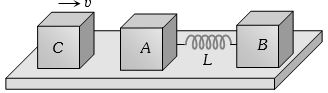
- 7Two blocks $A$ and $B$ each of mass m are connected by a massless spring of natural length L and spring constant $K$. The blocks are initially resting on a smooth horizontal floor with the spring at its natural length as shown in figure. A third identical block $C$ also of mass $m$ moves on the floor with a speed $v$ along the line joining $A$ and $B$ and collides with $A$. ThenView Solution
- 8$Assertion :$ The amplitude of an oscillating pendulum decreases gradually with timeView Solution
$Reason :$ The frequency of the pendulum decreases with time. - 9A particle is executing $S.H.M.$ with time period $T^{\prime}$. If time period of its total mechanical energy is $T$ then $\frac{T^{\prime}}{T}$ is ........View Solution
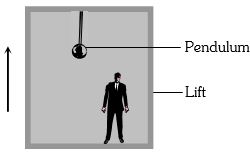
- 10A man measures the period of a simple pendulum inside a stationary lift and finds it to be $T$ sec. If the lift accelerates upwards with an acceleration $\frac{g}{4}$, then the period of the pendulum will beView Solution