Question
If the equation $\left(1+m^2\right) x^2+2 m c x+\left(c^2-a^2\right)=0$ has equal roots, prove that $c^2=a^2\left(1+m^2\right)$.

Answer

The given equation $\left(1+m^2\right) x^2+2 m c x+\left(c^2-a^2\right)=0$, has equal roots,
Then prove that $c ^2= a ^2\left(1+ m ^2\right)$
Here, $a=\left(1+m^2\right), b=2 m c$ and $c=\left(c^2-a^2\right)$
As we know that $D=b^2-4 a c$
Putting the value of $a=\left(1+m^2\right), b=2 m c$ and $c=\left(c^2-a^2\right)$
$\Rightarrow D=b^2-4 a c$
$\Rightarrow D=\{2 m c\}^2-4 \times\left(1+m^2\right) \times\left(c^2-a^2\right)$
$\Rightarrow D=4\left(m^2 c^2\right)-4\left(c^2-a^2+m^2 c^2-m^2 a^2\right)$
$\Rightarrow D=4 m^2 c^2-4 c^2+4 a^2-4 m^2 c^2+4 m^2 a^2$
$\Rightarrow D=4 a^2+4 m^2 a^2-4 c^2$
The given equation will have real roots, if $D=0$
$\Rightarrow 4 a^2+4 m^2 a^2-4 c^2=0$
$\Rightarrow 4 a^2+4 m^2 a^2=4 c^2$
$\Rightarrow 4 a^2\left(1+m^2\right)=4 c^2$
Hence, $c^2=a^2\left(1+m^2\right)$

Need a full question paper?

Generate a complete, print-ready paper with questions like this in minutes — across 16+ boards, with answer keys.

Start Generating Free

Similar questions


Image
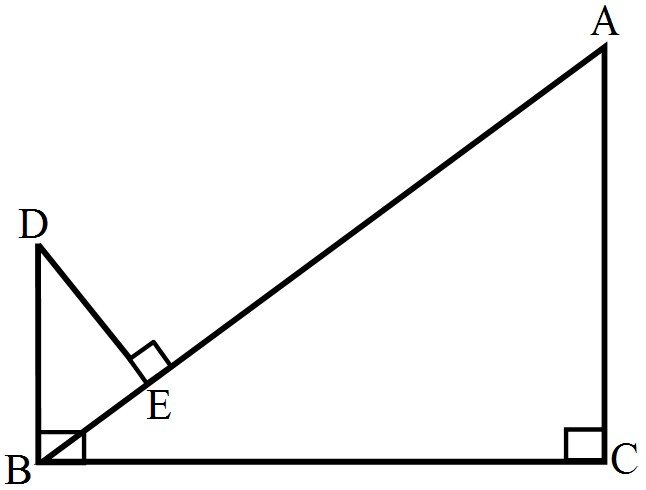
In the given figure, $\text{DB}\perp\text{BC},\text{DE}\perp\text{AB}$ and $\text{AC}\perp\text{BC}.$
Prove that $\frac{\text{BE}}{\text{DE}}=\frac{\text{AC}}{\text{BC}}.$
The students of a school decided to beautify the school on the annual day by fixing colourful on the straight passage of the school. They have $27$ flags to be fixed at intervals of every $2$ metre. The flags are stored at the position of the middle most flag Ruchi was given the responsibility of placing the flags. Ruchi kept her books where the flags were stored. She could carry only one flag at a time. How much distance did she cover in completing this job and returning back to collect her books? What is the maximum distance she travelled carrying a flag?
$\triangle PQR \sim \Delta PEF , m \angle P =70^{\circ}, PQ =5 cm, PR =3.5 cm$ Construct $\triangle PEF$, if $PQ : PE =5: 7$.
In a four-sided field, the length of the longer diagonal is 128m. The lengths of perpendiculars from the opposite vertices upon this diagonal are 22.7m and 17.3m Find the area of the field.
Find the value of x for which the numbers (5x + 2), (4x - 1) and (x + 2) are in AP.
Draw a line segment AB of length 8cm. Taking A as centre, draw a circle of radius 4cm and taking B as centre, draw another circle of radius 3cm. Construct tangents to each circle from the centre of the other circle.
Draw a circle with 'O' as centre and radius 4 cm. Take a point P at a distance of 7.5 cm from 'O'. Draw tangents to the circle through the point P.
Find the ratio in which the y-axis divides the line segment joining the points (5, -6) and (-1, -4). Also, find the coordinates of the point of division.